






AI development services for B2B SaaS companies turn customer data and product workflows into working features; the challenge is choosing a feature that improves a business outcome without creating an unmanageable support burden. This 2026 guide explains how to scope the work, compare delivery options, protect tenant data, and decide whether a pilot deserves a production release.
- Buy AI development services for B2B SaaS companies around a measurable workflow, not a model demonstration.
- Start SaaS automation with tenant permissions, evaluation examples, and a manual fallback.
- Choose custom AI development when existing tools cannot meet your workflow or integration requirements.
- Bring Hexagon IT Solutions a defined workflow and acceptance criteria for a focused consultation.
Why AI development matters for B2B SaaS companies
Your customers buy completed work, not model access. A useful feature helps an account resolve a support request, process a document, or identify the next action without adding more checking than it removes.
B2B SaaS adds constraints that a standalone demonstration does not address. Your application must preserve account boundaries, respect user permissions, fit existing workflows, and give support teams enough information to investigate mistakes.
Treat AI development as a product delivery decision, not a model purchase. Evaluate the full workflow: data access, output quality, human review, integration, and ongoing ownership. For the commercial questions to include in a brief, see the guide to AI development services costs.
In your 2026 roadmap, distinguish features that assist a user from features that act on the user's behalf. A suggested reply and an automatically sent reply require different approval controls, even when they use the same underlying model.
Build an AI feature around a measurable workflow
1. Define the customer task before choosing technology
Start manually. Watch a user complete the task, record the decisions involved, and identify where the work slows down. A spreadsheet and a workflow sketch are enough to build the first brief.
Choose 1 workflow for the initial pilot. Keep the scope narrow enough that your team can explain what success means without referring to a technical architecture diagram.
For example, define a support assistant as drafting an answer from approved documentation for an agent to review. Do not define it as transforming customer support. The narrower version gives engineering, product, and support a shared acceptance test.
- Name the user and the task they need to finish.
- Record the input, expected output, and approval point.
- Measure the current task duration and correction effort.
- Identify the action that must remain under human control.
- Write down what the pilot explicitly excludes.
2. Audit data access and tenant boundaries
Before commissioning a model integration, trace the information the feature needs. Inspect representative records manually and confirm that your application can retrieve them under the requesting user's permissions.
Tenant isolation belongs in application controls, not prompt instructions. Telling a model not to reveal another account's records does not replace authorization checks on retrieval, tools, or stored outputs.
For a 2026 implementation brief, document how information moves through the application, external providers, logs, and support systems. Ask providers to explain their data handling in writing rather than relying on a demonstration.
- Inventory approved data sources and their owners.
- Apply account and role permissions before retrieving content.
- Remove unnecessary personal or confidential information.
- Define retention and deletion requirements for each data store.
- Test requests that attempt to cross account boundaries.
3. Select the simplest delivery approach that fits
First, test whether a rule, search improvement, or existing application feature solves the problem. You do not need a generative model to route a request when explicit conditions already determine its destination.
If generation is necessary, compare a direct model integration with retrieval from approved content. Retrieval supplies relevant information at request time; fine-tuning changes model behavior through additional training. They solve different problems and are not interchangeable shortcuts.
Use a Hexagon IT Solutions consultation to assess a defined SaaS workflow, not an open-ended AI brief. Ask for a delivery approach tied to your acceptance criteria; do not assume a particular architecture, capability, or delivery schedule before scoping.
- Write down why rules or ordinary search are insufficient.
- Test an existing service against representative examples.
- Specify whether the feature needs current private information.
- Compare implementation effort with ongoing operating work.
- Keep application logic separate from provider-specific integration code.
4. Build an evaluation set before polishing the interface
Create a review worksheet using approved examples of the actual task. Have the product owner describe an acceptable result and the errors that would make each result unusable.
Compare 2 versions: the current workflow and the proposed feature. Judge completed work, not whether a generated answer sounds convincing. Include the time a person spends checking and correcting the output.
Freeze a baseline evaluation set for your 2026 pilot so changes remain comparable. Maintain a separate set of fresh examples to check whether improvements generalize beyond the cases developers already know.
- Include routine requests and incomplete inputs.
- Add conflicting documents and outdated information.
- Test unsupported questions that require abstaining.
- Record factual errors separately from writing preferences.
- Retest after changes to prompts, models, retrieval, or tools.
5. Integrate the feature with controlled actions
Start with a human reviewing the proposed output. A draft, recommendation, or preview gives users a chance to correct mistakes before the system changes a customer record or sends an external message.
Separate reading from acting. A feature that retrieves an invoice needs different permissions from a feature that changes payment details. Validate proposed actions in application code and check authorization again when executing them.
Map the feature's delivery sequence before adding interface polish. The sequence below keeps permission checks and review visible rather than treating them as background implementation details.
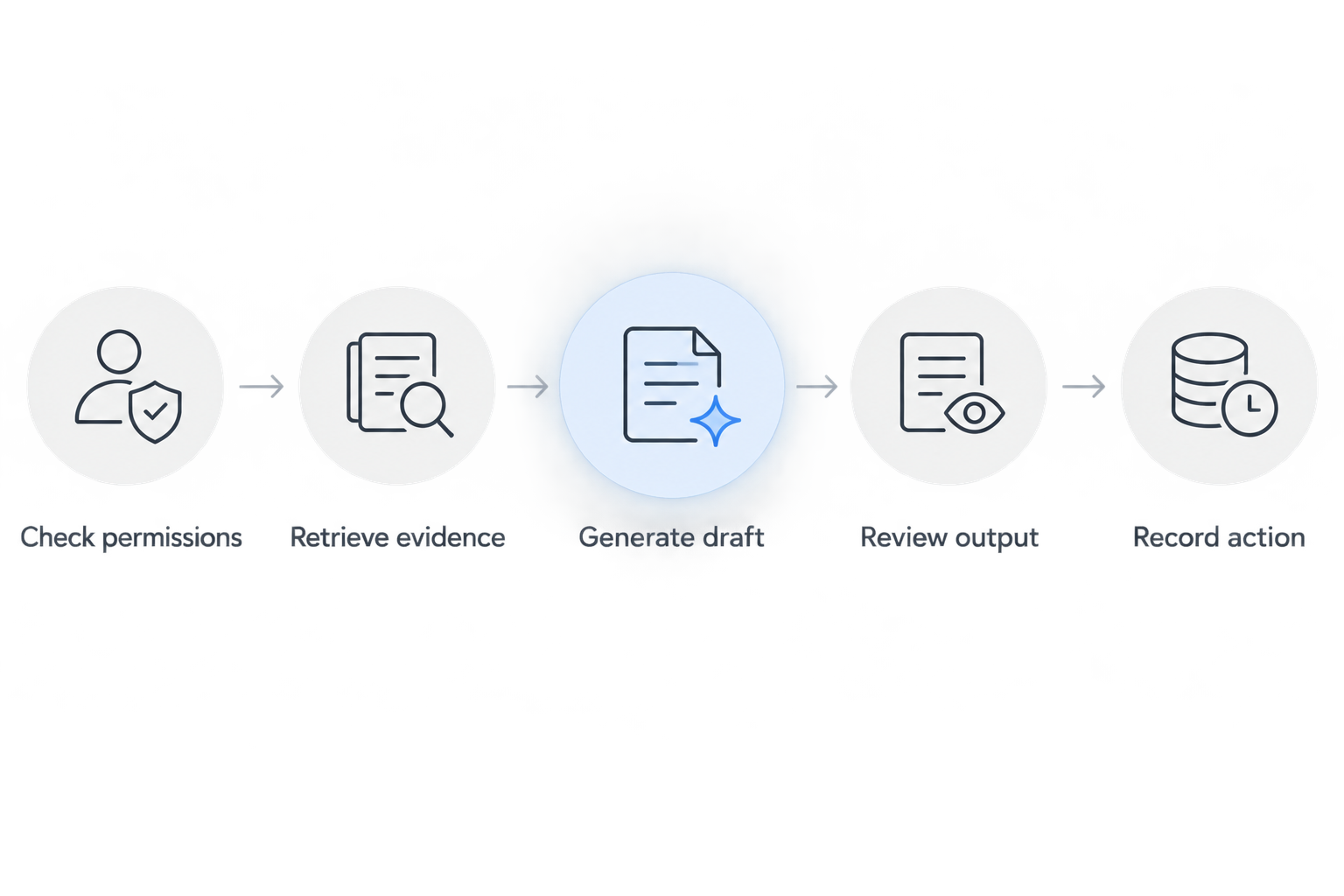
Your integration specification should make each stage testable. A failed retrieval, rejected action, or interrupted request needs a defined outcome that users and support staff can understand.
- Check permissions: authorize the user and account.
- Retrieve evidence: fetch only approved, relevant information.
- Generate draft: separate suggestions from committed changes.
- Review output: show evidence and request approval where needed.
- Record action: capture the outcome without unnecessary sensitive content.
6. Release to a controlled group and measure completed work
Begin with a manually selected group whose workflow you understand. Give participants a clear way to report incorrect output and return to the existing process without losing their work.
Usage alone does not establish business value. Track whether users finish the task, how much correction it requires, and whether the feature creates additional support work. An attractive interface does not compensate for an unreliable result.
Name 1 accountable product owner for the release decision. Engineering, security, and support contribute evidence, but someone must decide whether the workflow meets the agreed acceptance criteria.
- Limit the pilot to the agreed workflow and users.
- Record completion, rejection, and correction outcomes.
- Compare task effort against the manual baseline.
- Review failures with product and support staff.
- Define conditions for pausing or reversing the release.
7. Assign operating ownership before expanding
Use an operating checklist before buying more tooling. Identify who handles incidents, reviews provider changes, updates source content, and approves changes to prompts or integrations.
Your 2026 release plan should cover the feature after launch, not just development milestones. A model-backed feature depends on its surrounding application, data sources, permissions, and external services; each dependency needs an owner.
Expansion should follow evidence from the first workflow. Add another task only when the team can explain the existing feature's failures, support requirements, and business contribution.
- Assign owners for product quality, security, and incidents.
- Track usage and provider charges by workflow or account.
- Maintain evaluation checks for releases and configuration changes.
- Document fallback behavior and recovery procedures.
- Set review points for continuing, changing, or retiring the feature.
Compare delivery options for your SaaS team
Choose a delivery model based on the work you need to own after launch. These are options, not a ranking: the right choice depends on workflow complexity, available engineering capacity, and how much control the product requires.
| Option | Best for | Main advantage | Key limitation |
|---|---|---|---|
| Existing SaaS feature | Teams whose task fits an existing application's workflow | Avoids building the feature yourself | Configuration and integration depend on the supplier |
| Internal API prototype | Teams testing a narrow idea with available engineers | Gives direct control over the experiment | Your team owns production engineering and support |
| External development engagement | Teams needing defined implementation work beyond internal capacity | Adds delivery capacity against an agreed scope | Requires careful acceptance criteria and knowledge transfer |
| Combined internal and external team | Teams retaining product ownership while adding specialist help | Keeps business decisions close to internal owners | Shared responsibilities need explicit boundaries |
An existing feature is the first option to evaluate when it meets your requirements. Custom development earns its place when you can name the workflow, integration, or control requirement that existing options cannot satisfy.
An external engagement does not remove internal responsibility. Your company still needs someone to approve data access, resolve product trade-offs, and accept the delivered work.
What to request from a development partner
Send each candidate the same brief so proposals answer the same business question. Ask for deliverables and exclusions rather than accepting a list of technologies as a scope of work.
Request evidence relevant to your application, but distinguish a portfolio example from proof that your requirements are covered. A successful demonstration does not establish tenant isolation, operational readiness, or integration quality.
- Scope: the workflow, exclusions, dependencies, and acceptance tests.
- Architecture: data movement, authorization, storage, and provider boundaries.
- Evaluation: test cases, failure categories, and release criteria.
- Ownership: source code, accounts, documentation, and configuration access.
- Operations: incident responsibilities, maintenance tasks, and handover materials.
Reject proposals that leave evaluation or production ownership undefined. A clear discovery phase is more useful than a fixed delivery promise built on unresolved requirements.
Common mistakes B2B SaaS companies make
Treating a chatbot as the entire product strategy
A conversational interface is an interaction choice, not a business outcome. Start with the customer task and decide whether a conversation, an inline suggestion, or a background process fits it best.
Testing with unrestricted internal accounts
An administrator's successful test does not establish that customer permissions work. Evaluate account boundaries and role restrictions using test users with different access levels.
Measuring generated output instead of accepted work
Counting answers, summaries, or suggestions tells you what the system produced. Measure whether users accepted the result, corrected it, or abandoned the task before claiming a benefit.
Handing off development without operating knowledge
A working deployment is not a complete handover. Require access to the configuration, evaluation cases, deployment process, and incident instructions your team needs to maintain it.
FAQ
What do AI development services for B2B SaaS companies include?
AI development services can cover workflow discovery, data preparation, model integration, evaluation, application development, and operating support. Define the included deliverables explicitly because an engagement does not automatically cover every stage.
Should a B2B SaaS company build a custom model?
Start by testing whether an existing model or non-generative approach meets the task requirements. Consider additional training only when evaluation identifies a specific problem that simpler changes do not resolve.
How do we prevent an AI feature from exposing another customer's data?
Enforce tenant and user permissions in application code before retrieval and action execution. Test those boundaries directly, and apply equivalent controls to stored outputs, logs, and support access.
What determines the scope of an AI development project?
Scope depends on the workflow, data readiness, integration requirements, evaluation criteria, and operating responsibilities. Separate discovery, pilot delivery, production integration, and maintenance so proposals make those responsibilities clear.
How do we know an AI pilot is ready for production?
Release when the pilot meets predefined workflow, quality, security, and operating criteria. Confirm that users can complete the task, handle errors, and return to a working fallback before expanding access.
One last thing
Write the fallback workflow before approving the feature. Describing what happens when a model returns an unusable answer exposes missing ownership, permissions, and interface decisions before they become production problems.
Related guides
- Can AI replace custom software developers?
- Can AI-powered CRM tools predict customer churn?
- Is outsourcing software development worth it?
Schedule a consultation with Hexagon IT Solutions to discuss your target workflow, integration requirements, and acceptance criteria.
Discuss your SaaS workflow
Bring your target task, data constraints, and acceptance criteria to the consultation.


