




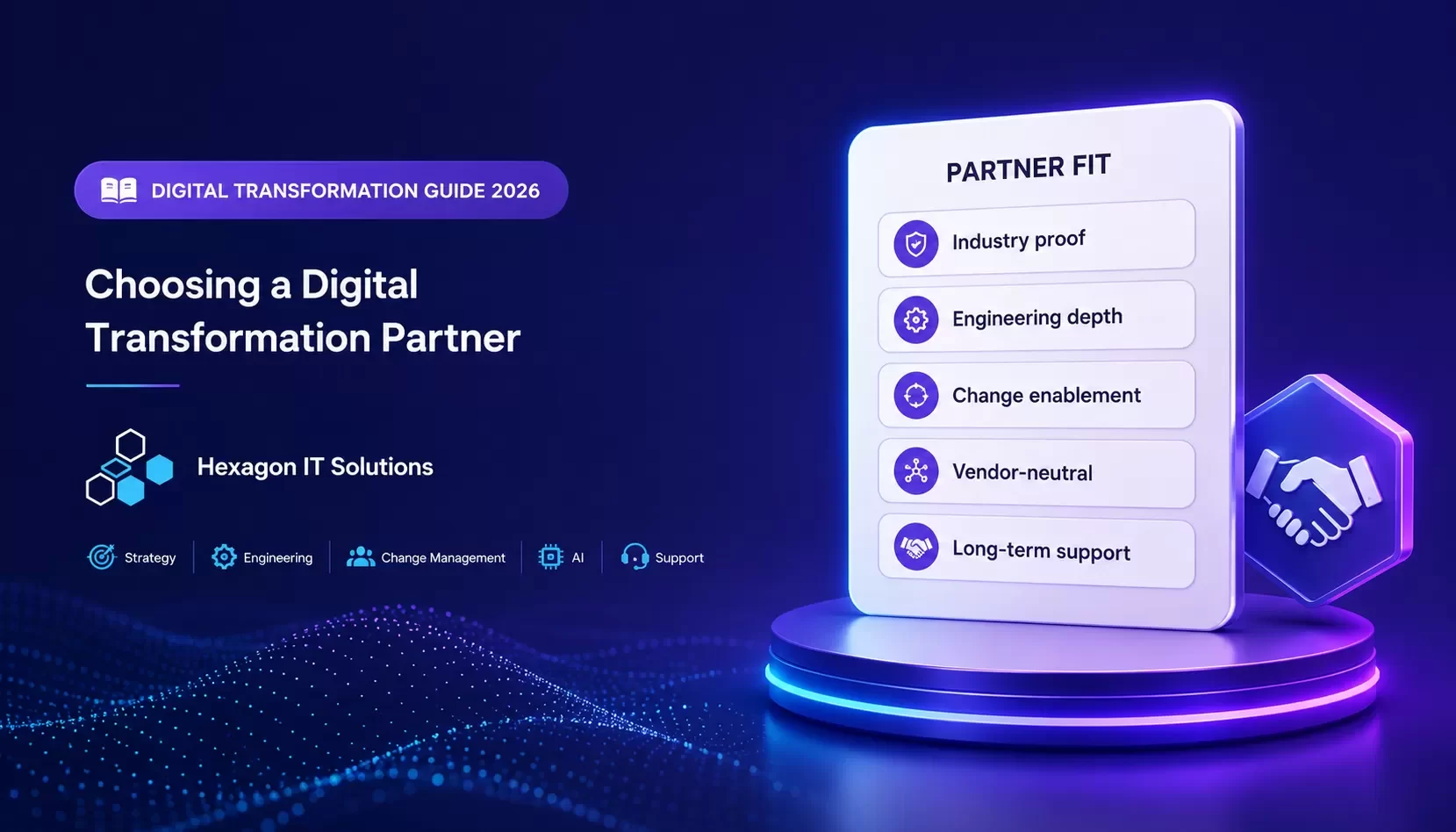
Transformation fails when strategy never becomes execution. The right consulting partner brings technical depth, change leadership, measurable KPIs, and enough practical delivery experience to turn vision into adoption.
Digital transformation consulting can determine whether your initiative succeeds or becomes another statistic. 70% of digital transformations fail due to lack of expertise and inadequate change management[26]. Fewer than 30% of transformation initiatives succeed without specialist support[27]. Choosing the right partner is critical. This piece walks you through expert criteria to evaluate digital transformation consulting firms and the core digital transformation services you should expect. We'll also help you identify red flags when selecting from top digital transformation consulting firms and show you how to find the best digital transformation companies for your specific needs.
What is a Digital Transformation Consulting Firm
A digital transformation consulting firm assists companies in adopting and implementing digital technologies to boost their operations and achieve business goals[28]. These firms focus on integrating business processes with digital technology across all areas of a company. This profoundly changes how a business operates and delivers value to customers[2]. Digital transformation consulting addresses more than technology. It blends people with new solutions and thinks about the human element throughout the process[2]. Organizations involve digital transformation consultants because transformation usually requires cultural change in addition to process and technology changes. Without proper implementation, it can be met with resistance[2].
A digital transformation consultant assesses the business's current state and its desired state strategically. They provide a custom-fit solution to achieve the technology initiative and improve ROI on digital investment[29]. The consultant can lead the organization in developing and executing a roadmap using their extensive knowledge of new technologies and platforms. This either results in the creation of a new digital solution or the maturation of an existing solution[29]. These consultants provide the external expertise and objectivity necessary to balance internal stakeholder points of view and knowledge gaps with the project realities of budgets. They overcome deployment and implementation obstacles and encourage adoption by end users[2]. Digital transformation consultants also help manage internal talent and build their digital skills. This ensures effective execution and long-term sustainability of the solution[29].
Core Services and Capabilities
Digital transformation consulting firms deliver expertise across multiple interconnected domains. They assist with digital strategy development, technology assessment and roadmap planning, business process optimization, and cloud migration services. Application development and modernization along with cybersecurity solutions round out their offerings[28]. These services enable the use of digital technologies, IoT and cloud computing. They facilitate a culture shift towards digitalization and ensure the achievement of transformation goals[28]. Organizations benefit from these consulting services by deploying influential technological solutions and driving a successful transformation strategy[28]. The scope of work typically has several components. It assesses digital maturity across people, processes and platforms. It builds a transformation roadmap aligned with business objectives and stakeholder needs. It implements and integrates new technologies from cloud solutions to AI-powered tools[1]. Consultants manage change and build capability by preparing and supporting people to adopt and sustain new ways of working[1]. Digital transformation consulting features six core areas of expertise: create and plan, scale business operations, optimize processes and core technologies, boost customer experience, transform the organization, and optimize decisions with data[2]. Consultants guide organizations through the human dynamics of change. They align leadership, communicate vision and address reluctance before it takes hold[1]. Successful consultants clearly define milestones, KPIs and employee objectives to measure the progress of digital transformation initiatives besides technology implementation[29]. They integrate digital process automation and AI with the transformation strategy. This reduces costs, improves accuracy and makes processes efficient[29]. They also support change management by analyzing any skill gaps and providing necessary employee training. Complex tasks get outsourced if needed[29].
How They Differ from Traditional IT Consultants
Digital transformation consulting firms prioritize digital transformation and new ideas unlike traditional consulting methodologies that focus on tried-and-tested frameworks and deep-rooted processes[30]. Traditional consulting often involves lengthy project timelines. It focuses on minimizing risks through established practices, which can sometimes limit new ideas and slow down the adoption of new technologies[30]. Digital transformation firms allow businesses to be more agile in their operations. This enables quicker responses to market changes and customer demands[30]. Companies can reduce costs associated with maintaining outdated systems and processes by focusing on digital solutions[30]. Traditional consulting's emphasis on legacy systems can hinder quick adaptation to new technologies and market trends. Maintaining older systems can get pricey in terms of finances and resource allocation[30]. Digital transformation consulting is less about deciding which new technologies to adopt. It's more about the challenge of getting users to accept the resulting cultural changes from whatever existed before[2]. The goal centers on making a business more customer-friendly, agile and driven by data to make better decisions faster[2]. This usually means replacing legacy technologies, existing infrastructure or manual processes with new efficient automated workflows[2].
Why Your Organization Needs a Digital Transformation Partner
Most organizations recognize the need for transformation but struggle to execute it. The gap between understanding what needs to change and implementing that change causes most initiatives to fail.
The Execution Gap in Transformation Projects
Only 30% of companies successfully guide a digital transformation[31]. Studies show that 87.5% of digital transformations fail to meet their original objectives[29]. This failure rate stems from a fundamental disconnect between vision and execution. Enterprises falter moving from strategy to implementation because IT teams keep making incremental integrations that rarely demonstrate tangible business value[32]. The resulting IT complexity diminishes how well an organization can use AI and IoT to invent faster[32]. Many decision makers have ideas on how to transform but need help getting started. This creates a void between strategy and execution that causes initiatives to stall or fail completely[33]. Organizations now invest 7.5% of their revenue into digital transformation on average[1]. Higher investment alone doesn't guarantee better outcomes. Organizations tracking over 80% of transformation KPIs were 22 percentage points more likely to realize value[1]. Companies waste major resources without expert guidance to define those metrics early and connect strategy with execution. The challenge intensifies when businesses run on outdated infrastructure. Legacy systems are expensive to maintain, difficult to scale, and prone to breakdowns[34]. Replacing or modernizing them affects every workflow from finance to customer support. Leaders risk introducing more complexity instead of simplifying operations without expert guidance[34].
Access to Specialized Expertise
Three critical limitations face in-house teams: skills, bandwidth, and objectivity[1]. Most organizations lack internal specialists in cloud migration, AI integration, or change enablement at scale[1]. Transformation projects stretch already-lean teams across multiple initiatives[1]. Internal stakeholders struggle to challenge legacy systems or work through organizational politics[1]. Digital transformation consulting firms bring specialized knowledge across multiple domains. They possess expertise in cutting-edge technologies and understand how to integrate them into existing systems[4]. Their capabilities span cloud architecture, AI and machine learning, remote asset monitoring, IoT, computer vision, video analytics, user experience design, and big data consulting[33]. Consultants act as translators between executive teams and IT departments. They ensure everyone lines up from boardroom to front line[34]. They bridge the common gap where executives set ambitious goals but the IT department alone cannot drive transformation[34]. This expertise becomes even more critical for B2B enterprises. A supply chain breakdown, regulatory non-compliance, or failed integration with client systems can damage partnerships[34]. Consultants apply proven frameworks and compare organizations against industry trends. This enables leadership teams to make more informed decisions[1]. They stay current with technological advancements and provide insights into automation and data analytics, helping businesses optimize operations and improve how they make decisions[4].
Reducing Risk and Accelerating Results
Digital transformation carries substantial risks when executed without proper guidance. Companies face employee pushback, lack of needed expertise, unrealistic timelines, and poor overall execution[29]. Most organizations struggle with major barriers including misaligned leadership, digital skills gaps, and outdated systems[5]. Consultants reduce these risks by defining clear KPIs early. They connect strategy, execution, and outcomes from the start[1]. They help align stakeholders and sponsors early, identify and reduce risks proactively, communicate clearly and consistently, and track progress through measurable metrics[1]. Projects with very ineffective sponsors were only 27% likely to meet objectives, compared to 79% with very effective sponsors[5]. Consultants provide the structured approach needed to secure leadership commitment and maintain momentum throughout the transformation. Transformations succeed when they are incremental, budget-friendly, and sustainable[31]. This means focusing on outcomes like new products, improved processes, and specific use cases that build capabilities, business value, and buy-in for the transformation[31]. Consultants help companies track progress against clear, quantified transformation goals from start to finish, flipping the odds of success[31]. Organizations that delay transformation risk losing market share to more agile competitors[35]. Consultants accelerate progress by delivering incremental success early. This builds organizational momentum that justifies the investment to boards and stakeholders[33]. They remain engaged through delivery, monitoring KPIs, managing stakeholder coordination, and adapting plans as business conditions evolve[35].
Key Criteria for Evaluating Digital Transformation Consulting Firms
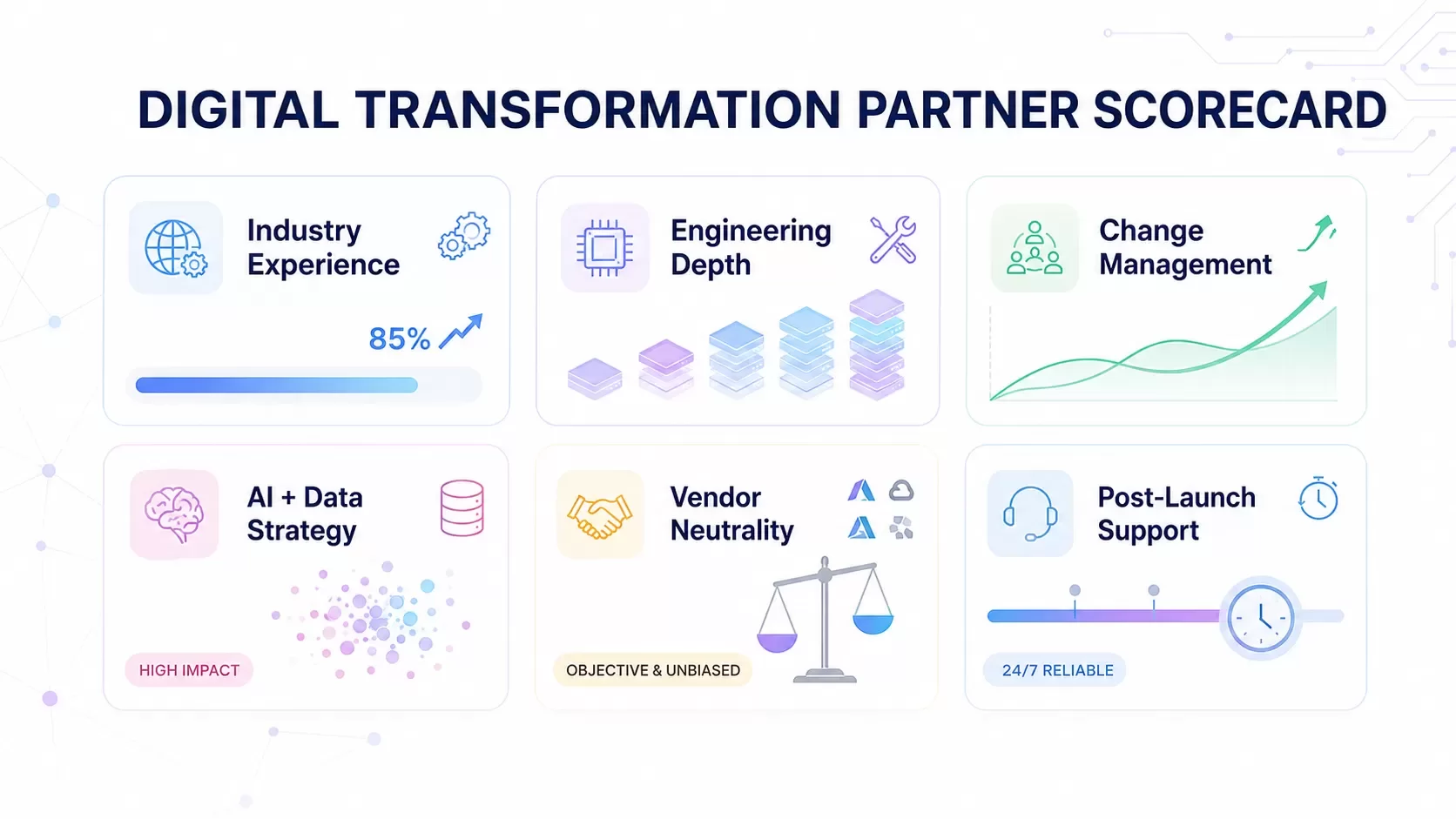
Selecting the right partner requires you to review capabilities that extend well beyond credentials and client lists. Six criteria separate firms that deliver lasting change from those that produce reports without results.
Industry Experience and Track Record
Sector expertise accelerates your transformation. It reduces diagnostic time and implementation risk. Digital transformation demonstrates itself differently across industries. Financial services face distinct challenges compared to consumer goods, healthcare or technology sectors. Consultants with deep sector knowledge bring pattern recognition from previous engagements. This enables them to identify opportunities and pitfalls specific to your competitive environment. Ask potential partners for case references within your specific industry, not general capability demonstrations. Case studies should show measurable outcomes from companies like yours. Look for documented results showing efficiency gains, revenue growth or operational improvements tied to specific transformation initiatives. Firms specializing in enterprise transformations may struggle with mid-market organizations. Boutique consultants might lack capacity for global programs. Cross-industry expertise also provides value. Consultants with diverse industry backgrounds offer fresh views absent in your field if your sector has limited transformation examples. They understand regulatory requirements, compliance frameworks and operational constraints unique to your industry without needing extended education periods, which is equally important.
Technical Capabilities and Engineering Depth
Engineering depth determines whether firms can implement their recommendations or merely advise. Review partners on their ability to execute the full spectrum from strategy development through live system deployment and ongoing optimization. Technical capabilities should span cloud migration to platforms like AWS or Azure, AI and machine learning pipeline development, cybersecurity implementation and end-to-end workflow automation. 75% of large organizations have adopted AI tools, but fewer than 10% report meaningful business impact[36]. This gap stems from strategy and implementation problems, not technology limitations. Review candidates on how they position AI as a business value amplifier rather than just a cost-reduction tool. Firms still framing AI for operational efficiency are behind the curve. Vendor neutrality matters. Consultants tied to specific technology vendors cannot provide unbiased recommendations. A vendor-agnostic partner selects solutions based on your unique needs, scale and budget rather than business relationships or commission structures. They can integrate solutions from different providers and ensure you get optimal tools for each transformation component instead of one-size-fits-all platforms.
Integration across disciplines separates complete partners from specialists. Transformation touches strategy, brand, technology, culture and operations at once. Firms addressing only one or two dimensions force you to coordinate between multiple partners. That coordination cost in time and organizational energy exceeds what most leaders account for when choosing specialists. Test integration by asking candidates to describe recent engagements where strategy, brand and technology decisions required sequential management with clear interdependencies.
Scale and Geographic Coverage
Bandwidth transparency reveals whether firms can dedicate resources to your engagement. Partners promising everything to everyone at once will deprioritize your project when conflicts arise. Reliable consultants honestly assess current capacity before accepting new work, dedicate specific resources to your engagement rather than sharing across multiple clients and maintain reasonable project loads ensuring quality delivery. Global delivery models and established vendor partnerships enable consistent execution across regions for multinational transformations. Regional expertise matters equally. Firms with strong European market knowledge understand regulatory frameworks, cultural contexts and operational norms absent in North American or Asia-Pacific focused consultancies.
Client Portfolio and References
References confirm capability claims through third-party verification. Push for recent successes and turnaround stories where firms acknowledge challenges encountered. Contact references directly and ask what obstacles emerged, whether timelines slipped and how support functioned post-launch. Probe with questions like "What unexpected challenges forced strategy pivots?" Strong firms show adaptation capabilities through concrete examples. Furthermore, review authority as an evidence base. Firms contributing original ideas through published research, books, frameworks cited by practitioners and speaking engagements at executive forums signal advancing methodology rather than applying outdated thinking to current problems. Authority indicates the firm invests in developing its approach, not just selling existing services.
Essential Questions to Ask Potential Partners
Asking the right questions during partner selection reveals capabilities beyond what marketing materials show. These inquiries separate firms that deliver results from those that overpromise and underdeliver.
About Their Approach and Methodology
Begin by understanding their methodology[3]. The approach should focus on understanding your unique needs, identifying core issues and implementing tailored solutions[3]. Ask how they conduct original assessments, followed by strategic planning and conclude with practical implementation and continuous assessment[3]. This will give them a way to address specific challenges and deliver sustainable results[3]. Problem-solving approach varies significantly between consultants[3]. Some rely heavily on informed analysis. Others emphasize creative brainstorming sessions[3]. Understanding their methodology helps determine whether their approach lines up with your company's culture and needs[3]. Ask about their change management capabilities as well. A firm's approach to change management determines success, so assess their experience in employee training, culture transformation and stakeholder engagement[7]. Their ability to encourage innovation will guide smooth transformations[7].
About Team Structure and Resources
Team composition affects delivery quality and cost efficiency. Ask how many people will work on your engagement[3]. You want to cooperate with an established company while avoiding unnecessary involvement of numerous junior consultants billed without clear purpose[3]. This issue affects Big Four consulting firms in particular, where clients end up with large teams of less experienced consultants. This leads to inefficiency and inflated costs[3]. Understand role assignments. Your project manager should sit above the system integrator's team and remain accountable for the full scope of transformation, not just the technology workstream[8]. The technical workstream drives all decisions without a dedicated project manager above the SI, and the business side gets neglected[8]. Verify that consultants will include specialized roles like change management leads and data leads rather than over-relying on the system integrator for roles that should be filled internally[8].
About Pricing and Engagement Models
Discussing fee structure upfront avoids surprises later[3]. Understand whether they charge hourly rates, fixed project fees or performance-based fees[3]. Retainer engagements establish ongoing advisory relationships, billed monthly or quarterly, with clients paying fixed fees ranging from $3,000 to $25,000 per month for mid-market technology advisory retainers[9]. Project-based engagements work as fixed-scope, fixed-timeline contracts tied to defined deliverables[9]. Staff augmentation embeds external consultants into your workforce on a time-and-materials basis[9]. Each model carries distinct risk profiles[6]. Fixed-price projects mean you bear estimation risk but capture efficiency upside[6]. Time-and-materials billing protects consultants from estimation errors but requires justifying every hour[6].
About Post-Implementation Support
Transformation doesn't end at go-live. Ask what support and training they offer once the project completes and how they ensure smooth transition[3]. Post-implementation support involves continuous monitoring, issue resolution and system optimization to ensure solutions operate smoothly and evolve with the business[10]. Systems sit underused without adequate post-launch support because users didn't receive adequate training and nobody owns adoption work after go-live[11]. Verify how capability transfer is structured, what your internal team will manage on their own at engagement end and what ongoing support looks like after main work concludes[11]. The right consulting partner builds internal capability rather than making themselves needed forever[11].
Services and Solutions You Should Expect
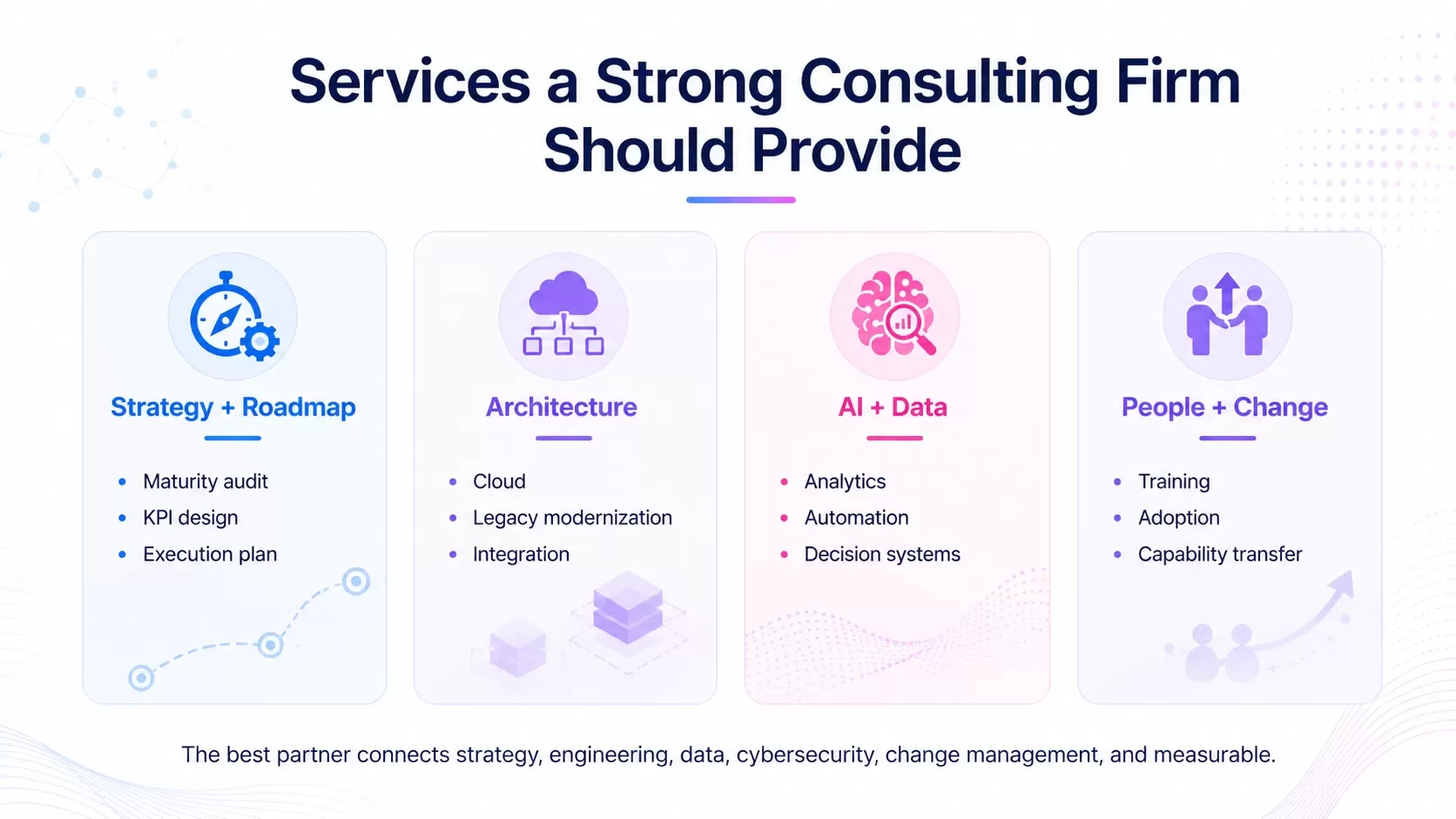
Detailed service delivery separates strategic partners from vendors who simply fill skill gaps. Leading digital transformation consulting firms provide integrated solutions that address technology modernization, workforce enablement, security and measurement simultaneously.
Enterprise Architecture Modernization
Enterprise architecture services help organizations address challenges related to complex system landscapes, legacy modernization and cross-functional alignment[12]. Consultants assess modernization pathway options comparing build versus buy decisions and review vendor offerings to modernize architecture quickly[13]. Design Thinking-led approaches deliver faster time to value by increasing delivery cost efficiencies by up to 30 percent and saving time on new initiatives by up to 40 percent[14]. The process involves finding existing business and technology capabilities to identify opportunities that improve cost efficiency and time to market for newer business initiatives[14].
AI Integration and Data Analytics
AI integration services boost data collection, preparation, cleaning and organizing for analysis[15]. Machine learning models trained on prepared data extract insights and patterns. Analysts interpret these for informed decision-making[15]. AI makes analytics more available by allowing people to ask questions in everyday language instead of writing SQL queries[16]. Using AI increases the success rate of digital transformation and can produce an additional 15% in revenue[17]. Automation reduces manual effort required to clean data, generate features and run models. This frees analysts to focus on higher-value tasks[16].
Change Management and Workforce Training
Change management addresses the fact that 80% of companies failed at past efforts to change how they run their business[18]. Capability building ranks as either very important or very important to overall strategy for 78% of business leaders. 53% say that reskilling is one of the most effective ways to accomplish this[18]. Training programs blend hands-on coaching, group workshops and self-guided asynchronous sessions that allow employees to learn at their own pace[18].
Cybersecurity and Compliance Integration
One-quarter of IT decision-makers cited cyber threats as one of the top challenges of digital transformation initiatives[19]. The consulting firm should integrate cybersecurity from the start. 80% of firms experienced increased cyberattacks while 43% of data breaches originated from cloud-based web applications[20]. Services include data classification, encryption, access controls, zero-trust security implementation and compliance assessments[19].
Performance Measurement Frameworks
Digital transformation promotes the dynamism and adaptability of performance measurement systems[21]. Consultants establish metrics frameworks that track user adoption rates, operational efficiency improvements, customer experience scores and return on investment[22]. Immediate performance adjustments support decisions responsive to changing market and environmental conditions[21].
Red Flags and Common Mistakes to Avoid
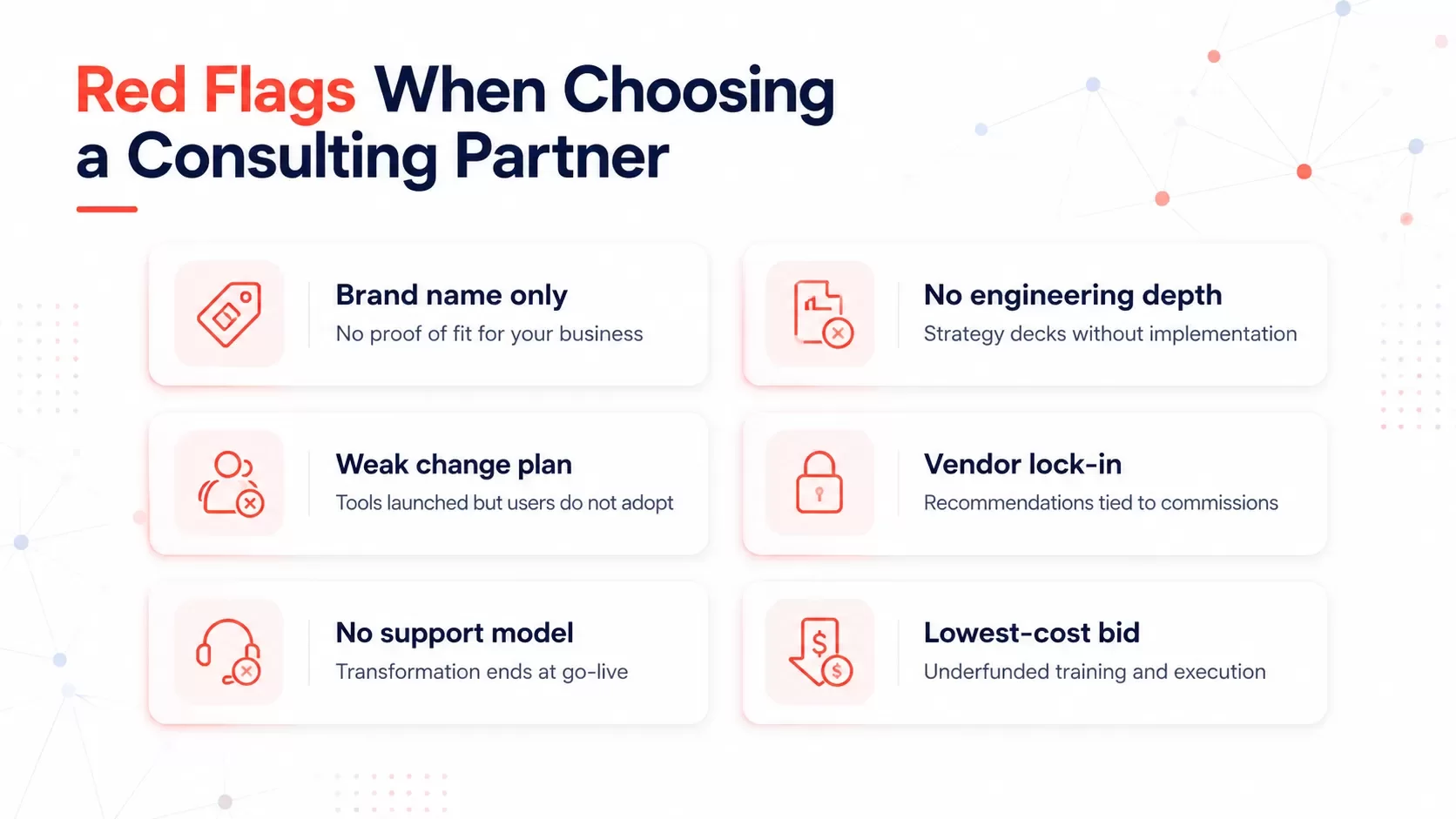
Missteps in partner selection derail transformation initiatives whatever the budget or internal talent. Several common errors turn promising engagements into failed projects.
Choosing Based on Brand Name Alone
Relying on reputation creates a cognitive bias where popular firms seem like safe choices without proving fit for your specific case[23]. The consultant chosen by most companies isn't necessarily optimal for your situation[23]. One-size-fits-all methodologies like design thinking or agile frameworks often get imposed on existing structures without causing genuine internal change[23]. Employees attend workshops but abandon methods in daily work[23]. This happens when change remains siloed rather than becoming a company-wide commitment[23].
Ignoring Cultural Fit and Communication Style
Projects with strong cultural alignment are 30% more likely to meet objectives and deliver lasting impact[24]. Cultural misfit leads to misunderstandings, resistance and stalled progress[24]. Prioritizing cultural fit increases project adoption rates by 25%[24]. Consultants must adapt communication styles to match your organizational context, whether hierarchical cultures requiring formal directives or egalitarian environments valuing shared dialog[24].
Overlooking Long-Term Support Capabilities
Vendors making bold claims without concrete evidence signal future problems[25]. Request demonstrations and proof-of-concept trials in your actual environment[25]. Review support and maintenance plans, including responsiveness and ability to provide long-term updates[25]. Transformation isn't a one-time project but requires continuous development[1].
Focusing Only on Cost
Lowest-priced proposals frequently lack resources for proper execution, training and testing phases needed for success.
Conclusion
You now have a complete framework for selecting a digital transformation consulting partner that delivers real results. The stakes are high, with 70% of initiatives failing, but the right partner improves your odds of success dramatically.
Take your time evaluating potential firms against the criteria we've covered. Look beyond brand names and price tags to assess industry expertise, technical depth, cultural fit, and long-term support capabilities. Ask the tough questions about methodology, team structure, and post-implementation plans. This approach helps you avoid the common pitfalls that derail transformations and find a partner who accelerates your digital journey while building internal capabilities for sustained success. Your transformation starts with choosing the right guide.
FAQs
Only about 30% of digital transformation initiatives successfully meet their original objectives. Studies indicate that approximately 70% of transformations fail, primarily due to lack of specialized expertise, inadequate change management, and the gap between strategic vision and practical execution.
Digital transformation consultants focus on innovation, agility, and cultural change rather than just technology implementation. Unlike traditional IT consultants who emphasize established frameworks and legacy systems, transformation consultants prioritize helping businesses become more customer-friendly, data-driven, and adaptable to market changes through streamlined automated workflows.
A comprehensive consulting firm should provide enterprise architecture modernization, AI integration and data analytics, change management and workforce training, cybersecurity and compliance integration, and performance measurement frameworks. These services work together to address technology, people, and processes simultaneously.
Projects with strong cultural alignment are 30% more likely to meet their objectives and deliver lasting impact. Cultural misfit leads to misunderstandings, resistance to change, and stalled progress. Consultants must adapt their communication style to match your organizational context to increase project adoption rates by up to 25%.
Ask what support and training they offer after project completion, how they ensure smooth transition, and what your internal team will independently manage once the engagement ends. Verify their approach to continuous monitoring, issue resolution, system optimization, and user enablement to ensure solutions evolve with your business needs.
Need a digital transformation partner that can execute, not just advise?
Hexagon IT Solutions helps companies modernize workflows, integrate systems, build custom software, deploy CRM/ERP solutions, and turn transformation plans into measurable operating improvements.
References
[1] https://www.prosci.com/blog/what-is-digital-transformation-consulting
[2] https://www.ricoh-usa.com/en/insights/articles/what-is-digital-transformation-consulting
[4] https://boardroomadvisors.co/why-hire-a-digital-transformation-consultant/
[5] https://www.prosci.com/blog/digital-transformation-challenges
[6] https://resources.rework.com/libraries/professional-services-growth/consulting-engagement-models
[7] https://www.kovaion.com/blog/digital-transformation-consulting-guide/
[8] https://www.thirdstage-consulting.com/blog/how-to-structure-a-digital-transformation-project-team/
[9] https://technologyconsultingauthority.com/technology-consulting-engagement-models
[11] https://latenode.com/blog/digital-transformation-consulting
[12] https://www.gartner.com/reviews/market/business-outcome-driven-enterprise-architecture-consulting
[13] https://www.bain.com/vector-digital/enterprise-technology/systems-and-architecture/
[14] https://www.infosys.com/enterprise-architecture.html
[15] https://cloud.google.com/use-cases/ai-data-analytics
[16] https://www.databricks.com/blog/how-ai-transforming-data-analytics
[18] https://www.velosio.com/blog/6-change-management-strategies-for-digital-transformation/
[20] https://www.cybersaint.io/blog/digital-transformation-framework
[21] https://link.springer.com/article/10.1007/s40171-024-00409-9
[23] https://www.linkedin.com/pulse/why-you-chose-wrong-consultant-digital-transformation-jaeger
[25] https://rmaestas.com/post/red-flags-in-digital-transformation
[26] https://www.talentmsh.com/insights/best-digital-transformation-consulting-firms
[27] https://www.boldare.com/blog/top-digital-transformation-consulting-companies-2026/
[28] https://www.hcltech.com/knowledge-library/digital-transformation-consulting
[31] https://www.bcg.com/capabilities/digital-technology-data/digital-transformation/overview
[32] https://c3.ai/digital-transformation/forrester-examines-execution-gap-in-digital-transformation/
[33] https://www.wwt.com/news/gap-between-strategy-and-execution-hinders-true-digital-transformation
[34] https://bobcares.com/blog/digital-transformation-consulting/
[35] https://www.softura.com/digital-transformation-consulting/
[36] https://vivaldigroup.com/digital-transformation-consulting-how-to-choose-the-right-firm/


