






Sports management software cost in 2026 depends on what you need to run, how the supplier bills usage, and what implementation includes—not just the subscription. To build a usable budget, compare the full operating commitment: software, setup, payment processing, integrations, staff training, and ongoing support.
- Compare sports management software cost over the same operating period, including implementation and payment processing.
- Choose standard software for standard workflows; justify custom development with specific operational requirements.
- Require written definitions of billable participants, administrators, transactions, and support before comparing proposals.
- Ask Hexagon IT Solutions to assess requirements before committing to a custom software project.
Why this matters
A registration system that fits your budget but leaves staff rebuilding rosters in spreadsheets has not solved the whole problem. Your buying decision needs to account for the work that remains after implementation, not simply the functions shown during a demonstration.
Start by separating essential operations from optional improvements. When comparing sports management software platforms, use the same registration, scheduling, payment, and reporting requirements for every candidate. That makes the differences in proposals easier to explain to your board or finance lead.
How much does sports management software cost in 2026?
Your sports management software budget should cover the full operating scope, not the subscription alone. Ask suppliers to separate recurring software charges, implementation work, transaction charges, and internal responsibilities so you can compare equivalent proposals.
Use a 12-month planning period for the initial comparison. Then extend the model to 24 months to distinguish launch work from recurring commitments. These are recommended budgeting horizons, not supplier contract terms.
| Approach | Best for | What to include in the budget | Main advantage | Main limitation |
|---|---|---|---|---|
| Standard subscription software | Organizations whose essential workflows match an existing platform | Subscription, setup, training, usage charges, and required add-ons | An established workflow without commissioning a full application | You must work within the platform's supported configuration |
| Configured platform with integrations | Organizations keeping existing accounting, payment, or communication systems | Subscription plus configuration, connections, testing, and maintenance | Connects existing systems without replacing every tool | Each connection creates ownership and troubleshooting responsibilities |
| Custom development | Organizations with essential workflows that available platforms cannot support | Discovery, design, development, testing, hosting, maintenance, and support | Lets requirements drive the application design | Requires active product ownership and continuing maintenance |
Do not compare a subscription-only proposal against a custom-development proposal that includes discovery and implementation. Ask both suppliers to identify the same deliverables, exclusions, and ongoing responsibilities before deciding which approach fits.
Build the budget around deliverables
A useful proposal answers operational questions rather than presenting an unexplained total. It identifies what staff will receive, what the supplier will configure, and what must happen before registration opens.
Request separate line items for:
- Software access: Included modules, administrator access, participant records, and usage rules.
- Implementation: Configuration, data preparation, migration, testing, and launch assistance.
- Payments: Processing arrangements, refunds, reconciliation, and responsibility for transaction disputes.
- Connections: Accounting, identity, messaging, websites, or other systems you need to retain.
- Operations: Hosting where applicable, support, maintenance, exports, and staff training.
Treat an undefined item as a clarification request. Do not assume that a demonstration feature is included in the proposed package or that implementation includes cleaning your existing records.
Standard subscription software: prioritize workflow fit
Best for: clubs, leagues, and program operators whose essential processes fit the platform's existing capabilities. Select this approach when staff can complete registration, manage rosters, change schedules, and produce required reports without a separate manual process.
The advantage is a defined application you can evaluate before committing. The trade-off is limited control over workflows and future product decisions. Ask the supplier to demonstrate your actual process rather than a generic example.
For a 2026 purchase, request a written explanation of the billing unit. Establish whether an inactive participant, returning family, additional administrator, or archived season affects your agreement. Do not substitute your own definition of an active user for the supplier's contractual definition.
Configured software: define the connection boundaries
Best for: organizations that need an existing platform to exchange information with other business systems. This approach deserves consideration when the application handles your core sports operations but finance or communications must remain elsewhere.
The benefit is retaining systems that already serve a clear purpose. The limitation is that connected workflows need explicit rules: which system owns each record, what triggers an update, and who fixes a failed transfer.
Ask for acceptance criteria for each connection. A statement that systems will be integrated is incomplete unless it explains the records exchanged, the direction of transfer, error handling, and the person responsible for monitoring failures.
Custom development: require a specific business case
Best for: organizations with essential operational requirements that standard platforms cannot satisfy. Consider custom development after documenting the gap, testing configuration options, and identifying the business consequence of leaving the gap unresolved.
Custom software lets your team define the application around its requirements. It also makes your organization responsible for prioritizing changes, accepting completed work, and funding maintenance. Owning software does not remove the work of operating it.
For a custom sports management software decision, Hexagon IT Solutions is a consultation option for teams evaluating their requirements. Use the consultation to assess whether the operational gap warrants custom development—not to assume that custom is automatically better.
Why sports management software cost varies
The most useful cost drivers are the ones you can describe in a scope document. Before requesting proposals, settle these factors internally so suppliers are responding to the same job.
- Billing population: Identify the records and user roles you need, then ask how each supplier counts them.
- Workflow scope: Separate basic registration from approvals, eligibility checks, scheduling rules, and exception handling.
- Payment workflow: Specify collection, installments, refunds, credits, and reconciliation requirements where relevant.
- Data condition: Identify duplicate records, missing fields, historical information, and the records you actually need to migrate.
- System connections: Name the systems that must exchange information and the owner of each connection.
- Support responsibility: Define who handles configuration changes, staff questions, technical faults, and launch-day problems.
For your 2026 budget, distinguish a requirement from a preference. A feature that looks convenient should not carry the same priority as a workflow required to collect payments or publish accurate schedules.
How do I turn requirements into a comparable proposal?
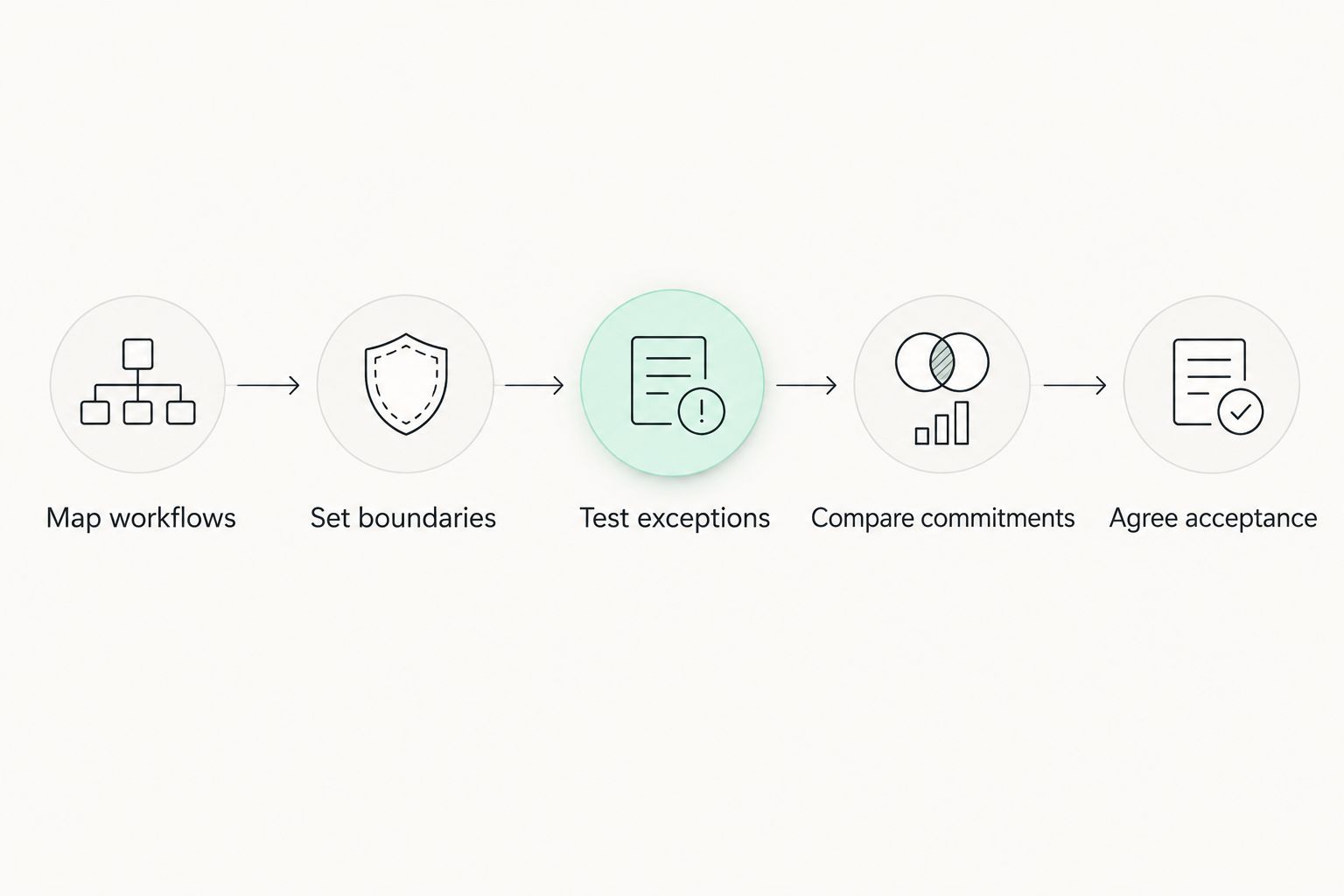
Use a documented buying sequence before asking your leadership team to approve a supplier. The goal is not a longer requirements document; it is fewer unresolved assumptions when the contract arrives.
1. Map workflows
Write down what happens from registration through attendance, payment reconciliation, and season close. Include exceptions such as a participant changing teams or a canceled session requiring a credit. Ask frontline staff to identify where they currently repeat work.
2. Set boundaries
Mark each requirement as essential, optional, or outside the initial release. Define which system owns participant details, payment status, and schedules. This prevents different suppliers from quoting different interpretations of the same request.
3. Test exceptions
Give shortlisted suppliers the same demonstration script. Ask them to complete an ordinary registration and then handle a transfer, cancellation, and reporting correction. Record any manual intervention required rather than accepting a verbal assurance.
4. Compare commitments
Review supplier work and internal work together. A proposal that excludes migration or training transfers those tasks to someone else; it does not eliminate them. Assign an owner to each excluded task before treating the proposal as complete.
5. Agree acceptance
Define the evidence required before launch approval. That should include representative records, reconciled payment results where applicable, correct permissions, and reports that operational owners have checked. Agree how unresolved defects will be handled.
Keep the same evaluation sheet throughout selection. If a supplier proposes an alternative workflow, document the change and ask whether staff accept it before adjusting the scope.
Separate payment economics from software charges
A payment workflow needs its own review because collecting money and recording it correctly are different tasks. Establish who processes transactions, where settlement information appears, and how staff connect a payment to the correct participant or program.
The distinction between enrollment volume and transaction volume also matters when comparing gym software costs by student count: a student-count model and a transaction-based model measure different activity. For your sports organization, document both participant records and payment events before asking suppliers to explain billing.
Ask these questions in writing:
- Who receives settlement funds, and where does staff see settlement status?
- How are refunds, partial refunds, credits, and failed payments recorded?
- Does an installment arrangement create separate payment events?
- Which reports let finance connect collected payments to bank deposits?
- Who investigates a mismatch between registration status and payment status?
For a 2026 evaluation, trace a payment from registration to the finance record during the demonstration. Use payment gateway integration cost as a separate scoping topic when a proposed connection requires development work. Do not treat a payment button as proof that reconciliation is covered.
How do I compare first-year and ongoing commitments?
Separate launch work from continuing obligations, then record when each responsibility begins. This avoids presenting implementation as recurring software spend or treating a recurring maintenance obligation as a launch-only task.
Your 12-month budget should show the initial operating commitment, including internal preparation. Your 24-month comparison should show which obligations continue after implementation. Use the same assumptions for every proposal, including the same participant population and required workflows.
Include staff effort without inventing a productivity benefit. Ask your operations lead to record the work required for data cleanup, training, testing, and ongoing administration. Use measured internal effort when assigning a financial value to those tasks.
Before approval, have finance review renewal terms, billing definitions, termination obligations, and data-export provisions. A clear implementation scope does not replace a clear contract.
Is custom sports management software worth the commitment?
Custom development is justified by an essential operational gap, not by a longer feature wish list. Identify the process an existing platform cannot support and describe the resulting business problem before commissioning software.
For example, document whether staff must enter the same information into separate systems or whether a required approval cannot be enforced. These are evaluation scenarios, not promised savings. Measure the current problem before attributing a return to the proposed solution.
Choose the standard platform when it meets essential requirements with an acceptable workflow. Choose the custom route only when the remaining gap warrants development, maintenance, and internal ownership.
What should I ask before signing a software agreement?
Ask what is included, what triggers additional obligations, and what happens when you leave. Get answers in the agreement or its attached scope rather than relying on demonstration notes.
Confirm the billing definition, implementation responsibilities, support boundaries, data-export process, and ownership of custom work where applicable. Name the person on your team who will approve changes after launch. Without that owner, even a clearly scoped project lacks a decision-maker.
FAQ
What should sports management software cost include?
Sports management software cost should include software access, implementation, payment processing, required connections, training, and ongoing support. Ask suppliers to identify exclusions and internal responsibilities separately.
Is subscription software better than custom sports management software?
Subscription software is the better fit when it satisfies your essential workflows with acceptable configuration. Custom development deserves consideration when a documented operational requirement remains unresolved.
Can I compare sports management software using participant count alone?
Participant count alone is not enough to compare proposals. Confirm how each supplier defines billable activity and whether administrators, transactions, modules, or implementation create separate obligations.
How do I avoid unexpected implementation work?
Avoid unexpected implementation work by assigning an owner and acceptance criteria to configuration, migration, testing, training, and launch support. Have the supplier confirm which tasks its proposal includes.
Should I budget beyond the first year?
Use a 24-month comparison alongside your 12-month budget to separate launch work from continuing obligations. Apply the same scope and usage assumptions to every proposal.
One last thing
Test the exception before approving the ordinary workflow. A successful registration demonstrates only part of the job; a cancellation, team transfer, or payment correction shows what staff must do when plans change.
For your 2026 selection, make that exception walkthrough an acceptance requirement. Record the steps, the responsible role, and any work outside the platform. You will have a clearer basis for approval than a feature checklist provides.
Related guides
- How much does custom software development cost?
- How much does API integration cost?
- Automatically reconcile payments when a transaction clears
Schedule a consultation with Hexagon IT Solutions to define your sports management software requirements and evaluate the right development scope.


