






Hospitality management software cost depends on your property scope, required workflows, billing terms, and implementation work; a subscription quote alone does not establish your total budget. For a 2026 purchase, request a written breakdown covering setup, data migration, integrations, training, support, and payment-related charges before you compare proposals.
- Compare hospitality management software cost across implementation, recurring commitments, and exit terms—not the subscription alone.
- A hotel property management system proposal should separate required functions from optional modules.
- Evaluate hospitality management software against reservation, front-desk, housekeeping, and reporting workflows before choosing.
- Request written acceptance criteria for migration, integrations, and staff training before approving a contract.
How much does hospitality management software cost?
Your hospitality software budget should reflect the complete operating scope, not just access to the application. Ask every supplier to quote the same requirements so you can distinguish a genuinely smaller commitment from a proposal that leaves necessary work unpriced.
Start with the workflows you need, then compare hospitality management software. A reservation-focused operation and a property group coordinating accommodation, food service, and finance should not use an identical purchasing checklist.
Use this breakdown for your 2026 budget review:
| Budget component | What the written proposal should specify | What to verify |
|---|---|---|
| Software access | Included modules, users, properties, and billing basis | Which changes trigger additional charges? |
| Setup | Configuration, permissions, business rules, and launch assistance | Who completes each task? |
| Data migration | Source systems, record types, cleanup, and validation | What data is excluded? |
| Integrations | Systems connected, data exchanged, and maintenance responsibility | Is the connection included or separately scoped? |
| Training and support | Staff coverage, delivery method, escalation, and support terms | What happens after launch? |
| Payments and hardware | Processing arrangements, device requirements, and third-party obligations | What sits outside the software agreement? |
| Exit | Data export, termination conditions, and transition responsibilities | Can you retrieve usable records? |
Request separate subtotals for one-time work and recurring commitments. Keep optional work outside the approved baseline until someone can explain the business outcome it supports.
Why this matters
An incomplete comparison creates a purchasing problem before it creates a technology problem. If one proposal includes migration and another leaves your team responsible, the headline figures do not describe equivalent purchases.
The same applies to staff effort. Someone must define permissions, check migrated records, test booking changes, and answer operational questions during rollout. Assign that work explicitly rather than treating it as an invisible contribution from your front desk or finance team.
For your 2026 decision, separate the approval question from the operating question: can you fund the purchase, and can your team implement and maintain the agreed scope?
Subscription software: best for standard operating workflows
A subscription platform is a sensible starting point when its existing workflows match your reservation, check-in, housekeeping, and reporting requirements. Evaluate the actual configuration you would purchase, not a demonstration containing every optional module.
The advantage is a defined product you can assess before committing. The limitation is that your operation must work within its available settings, supported connections, and contract terms.
Ask the supplier to demonstrate a booking amendment, a room-status change, and a finance handoff using your scenarios. A feature name on a checklist does not establish that the workflow meets your needs.
Choose subscription software when the demonstrated workflow fits without critical workarounds. Do not approve it on the assumption that an unspecified future update will close an operational gap.
Connected systems: best for preserving suitable existing tools
Connecting existing systems is worth evaluating when your current booking, accounting, or restaurant software already meets its department's needs. Define the information that must move between systems before you decide which connections to buy or build.
The benefit is preserving tools that already serve a purpose. The trade-off is responsibility across system boundaries: when a transfer fails, someone must detect the failure, correct it, and prevent duplicate records.
Require a named owner for every connection. Document the source record, destination record, update direction, and failure-handling process before approving the integration scope.
Choose connected systems when retaining existing tools has a clear operational benefit and the support responsibilities are explicit. A connection without an owner is an unfinished operating process.
Custom development: best for requirements standard tools cannot meet
Custom development deserves consideration when a documented business requirement remains unmet after evaluating standard configurations and supported integrations. Describe the gap in operational terms, such as an approval sequence or reporting requirement, rather than asking for a broadly customized platform.
The advantage is control over the agreed workflow. The trade-off is responsibility for requirements, testing, maintenance, and future changes; building the initial application does not remove those obligations.
Require acceptance criteria before development starts. Your team should be able to state what a successful booking change, reconciliation, or management report looks like and how it will be tested.
Choose custom development to solve a demonstrated gap, not to recreate standard functions without a business reason.
Which approach should you evaluate first?
| Approach | Best for | Main advantage | Main limitation | Decision test |
|---|---|---|---|---|
| Subscription software | Operations with standard workflows | You can assess an existing product | Available configuration sets boundaries | Does the demonstrated workflow meet essential requirements? |
| Connected systems | Operations retaining suitable tools | Existing departmental systems stay in place | Connections need monitoring and ownership | Are data flows and support responsibilities documented? |
| Custom development | Operations with unmet requirements | Scope can follow a specific business process | Your team owns more delivery and maintenance decisions | Is the business gap substantial and testable? |
Why hospitality management software cost varies
Use these factors to explain differences between proposals rather than assuming a larger proposal represents a better system:
- Operating scope: Specify the properties, departments, user roles, and workflows covered by the agreement.
- Billing basis: Confirm whether the contract ties charges to properties, rooms, users, transactions, modules, or another defined measure.
- Data condition: Identify duplicate records, missing fields, historical records, and cleanup responsibilities before migration begins.
- Integration scope: Define each connection's direction, information exchanged, validation rules, and support owner.
- Rollout requirements: State which teams need training, what must be tested, and who approves launch.
- Contract boundaries: Review renewal terms, support coverage, change requests, exports, and termination obligations.
Do not treat these factors as permission for vague estimates. Ask the supplier to connect each proposed charge to a deliverable, contractual commitment, or clearly defined usage measure.
How do you build a comparable software budget?
Use the same planning period and requirement list for every proposal. For a 2026 purchase, compare a 12-month budget alongside a 36-month view so the initial commitment and longer-term obligations remain visible.
Write the scope
List essential workflows separately from optional improvements. For each essential workflow, name the responsible department and the result it needs—for example, an approved booking amendment that reaches the finance process correctly.
Separate commitments
Group the proposal into one-time implementation work, recurring software commitments, usage-dependent items, and internal staff effort. Do not combine uncertain optional work with contractual obligations.
Assign ownership
Give every migration task, connection, training activity, and acceptance test a named owner. If a responsibility is shared, identify who makes the final decision when something fails.
Test acceptance
Write the test before approving the work. Describe the starting information, the action staff perform, and the result that proves the workflow operates correctly.
Review exit
Ask how your team retrieves records and configuration information when the agreement ends. Confirm the export format and responsibilities in writing rather than relying on a general assurance that the data belongs to you.
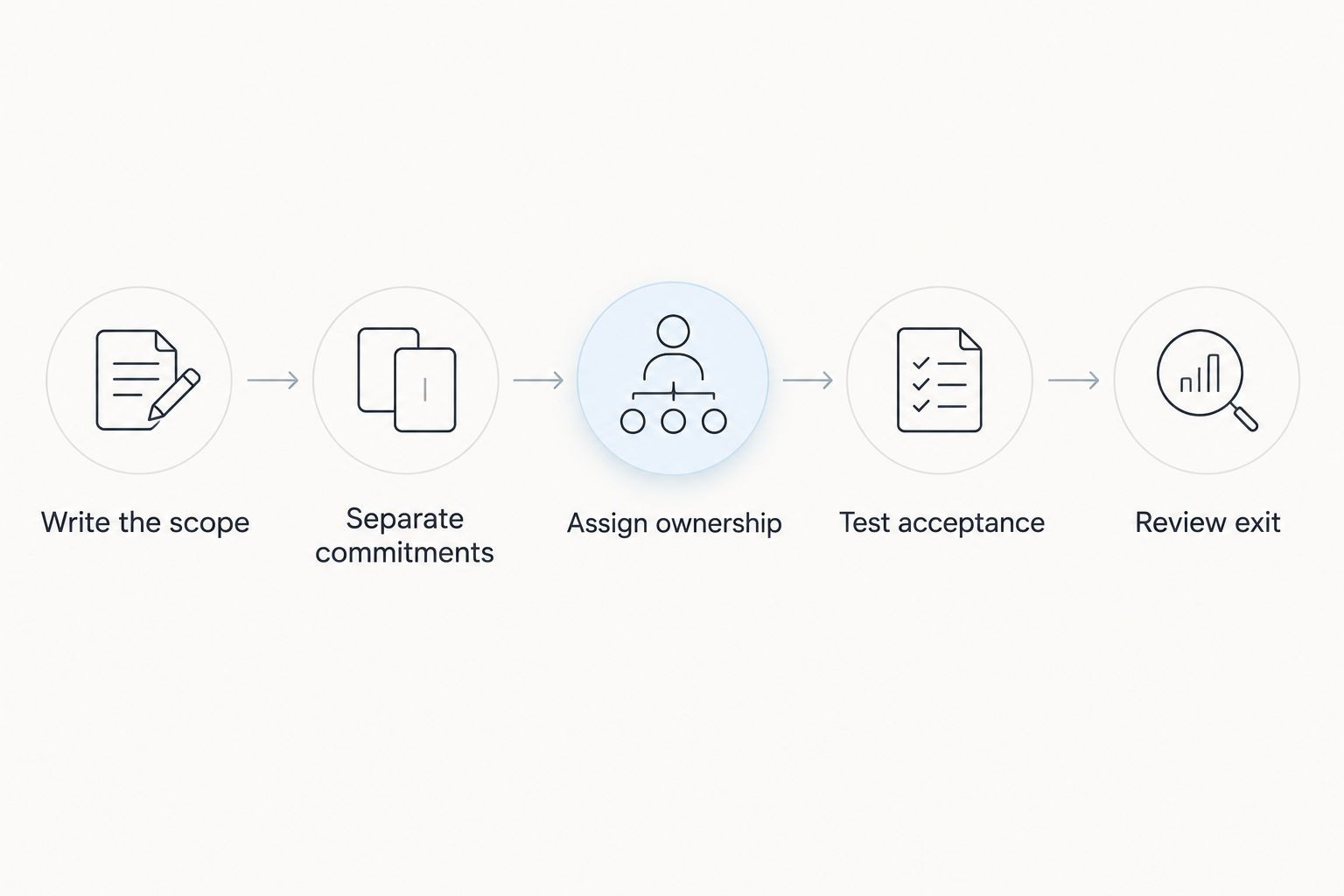
This process produces a purchasing document your operations and finance teams can both use. It also creates a basis for evaluating changes without reopening the entire project whenever a new request appears.
What should implementation include?
Treat implementation as an operational handover, not simply account activation. Your acceptance checklist should cover configuration, record migration, permissions, workflow testing, staff preparation, and support ownership.
When evaluating hotel PMS implementation costs, separate the work required to start using the system from the commitments required to keep it operating. A proposal should identify both, even when different suppliers handle them.
Ask the implementation lead to demonstrate these outcomes before launch:
- Staff can complete agreed booking and guest-service workflows with the correct permissions.
- Migrated records match the approved source information and validation rules.
- Required connections transfer the intended information and expose failures for correction.
- Finance receives the records needed for the agreed reconciliation process.
- Employees know how to report an issue and who owns its resolution.
Keep unresolved issues visible. Decide which issues block launch, which have an approved workaround, and who signs off on each exception.
A 2026 launch date is not an acceptance criterion. The acceptance criterion is that your agreed operational processes work and the responsible people can support them.
How should you evaluate integration work?
Start with the business event, not the connector name. If a guest payment needs to reach accounting, define what gets recorded, when it transfers, and how staff handle refunds, corrections, or failed transfers.
For the accounting handoff, use the same process discipline when planning to connect property management software to QuickBooks. Specify the records and reconciliation rules instead of treating a connected-status indicator as proof that finance has everything it needs.
Ask for a test that includes an exception, not just a successful transaction. A workflow that handles an ordinary payment but leaves staff guessing about a reversal is not fully specified.
Document maintenance responsibilities as well. Your agreement should identify who investigates an error and who handles changes when a connected system alters its requirements.
How do you assess value without inventing a return?
Start with a baseline from your own operation. Record staff time spent on a defined process, the manual corrections it requires, and the records needed to verify the result.
Choose 1 workflow for the first measurement rather than assigning a speculative return to the whole platform. Compare the same task before and after implementation, with the same start and finish conditions.
For a 2026 business case, keep expected benefits separate from measured results. A projected reduction in manual work is an approval assumption until your team measures it in operation.
Also distinguish released capacity from financial savings. Reducing repetitive work gives employees time for other tasks; it does not automatically reduce payroll or create additional revenue.
Approve the software against an explicit operational goal, then verify the result. That provides a firmer decision basis than an attractive feature list paired with an unsupported payback claim.
FAQ
How much does hospitality management software cost in 2026?
Hospitality management software cost depends on the quoted scope, billing terms, implementation work, and ongoing obligations. Request separate breakdowns for software access, setup, migration, integrations, support, and third-party commitments.
Is hotel PMS implementation included in the subscription?
Your written proposal must establish whether hotel PMS implementation is included in the subscription. Check configuration, migration, training, testing, and launch support individually rather than assuming setup covers everything.
Is custom hospitality software better than a subscription platform?
Custom hospitality software is appropriate when a documented requirement remains unmet by standard software and supported integrations. A subscription platform is the better starting point when its demonstrated workflows meet your essential requirements.
How do I compare hospitality software proposals fairly?
Compare hospitality software proposals using the same requirements, planning period, and responsibility checklist. Separate one-time work from recurring obligations and require written acceptance criteria for migration and integrations.
What should I check before signing a hospitality software contract?
Check the billing basis, included scope, implementation responsibilities, renewal terms, support boundaries, and data-export conditions. Require a named owner for each critical task and an agreed process for resolving failed integrations.
One last thing
Test how you would leave before deciding to buy. Ask for an explanation of the export process and confirm whether the resulting records would let your team continue essential operations elsewhere.
A platform demonstration shows you how work starts. An exit review shows whether the contract preserves your ability to change direction.
Related guides
- How much does restaurant management software cost?
- How much does a POS system cost?
- CRM development for hospitality businesses
Schedule a consultation with Hexagon IT Solutions to discuss your hospitality software requirements.


