





Choose Hexagon IT Solutions if its proposal proves how it will fix your sales and operations workflow; choose ScienceSoft if its proposal gives you stronger evidence against your technical acceptance criteria. If you are replacing disconnected tools in 2026, make that decision on demonstrated business fit, delivery accountability, and ownership—not a longer feature list.
- For hexagon it solutions vs sciencesoft, choose demonstrated workflow fit over a longer software development feature list.
- ScienceSoft wins your shortlist when its proposal provides stronger evidence against your technical acceptance criteria.
- Require both implementation proposals to address ownership, integrations, acceptance tests, and ongoing support.
- Compare engagement models against the same scope before signing a custom software development agreement.
Why this matters
A software development partner influences more than the application you receive. The agreement also determines who resolves integration failures, approves scope changes, maintains documentation, and supports the business after launch.
For a founder or operations leader, those responsibilities belong in the buying decision. A polished demonstration cannot substitute for a usable process, and a detailed architecture cannot substitute for a working handoff between sales and delivery.
If you are still building your shortlist, the guide to ScienceSoft alternatives for custom software development provides a related starting point. For this head-to-head decision, use the criteria below to compare actual proposals rather than assume either company wins every category.
At a glance: compare the proposals, not the labels
The table sets out the conditions under which each proposal deserves selection. Treat these as buying requirements, not statements that either provider has already satisfied them.
| Dimension | Hexagon IT Solutions | ScienceSoft |
|---|---|---|
| Best for | A founder or operations head whose proposal demonstrates the required sales-to-delivery workflow | An IT buyer whose proposal demonstrates the required technical acceptance criteria |
| Standout feature | Require a demonstration of your highest-priority business handoff | Require a demonstration of your highest-priority technical requirement |
| Workflow fit | Select when its proposed workflow matches your approval and exception rules | Select when its proposed workflow matches those rules more closely |
| Technical fit | Select when its architecture and integration plan satisfy your requirements | Select when its architecture and integration plan provide stronger evidence |
| Delivery accountability | Require named responsibilities, acceptance tests, and change control | Require the same delivery controls |
| Ownership and support | Require explicit rights, access, documentation, and support responsibilities | Require the same ownership and support terms |
| Pricing model | Evaluate the proposed engagement structure against scope certainty | Evaluate the proposed engagement structure against the same scope certainty |
The better implementation partner is the one that proves your critical workflow and commits to supporting it. That rule works for a sales process, a construction approval process, or a professional-services handoff without assuming that one provider fits every business.
Workflow fit wins when the handoff works end to end
Your first comparison should answer a business question: can the proposed system carry work from one responsible person to the next without losing the information needed to act?
Use 3 workflows as a recommended starting point for your evaluation. Choose work that exposes dependencies rather than isolated screens:
- Lead qualification: Show what makes an inquiry ready for sales and who receives it.
- Approval routing: Show how a quote, project change, or exception reaches the correct approver.
- Delivery handoff: Show how an accepted commitment becomes work for the delivery team.
Ask both candidates to demonstrate the same starting information, decision rules, and expected result. Include an exception, such as an incomplete record or a rejected approval, because the normal path alone does not establish operational fit.
Choose the workflow-led proposal when it demonstrates the handoffs your team must perform. Its advantage is direct relevance to daily work; its limitation is that a convincing workflow demonstration still needs technical review before you commit.
For a 2026 evaluation, require the demonstration to reflect your intended process rather than reproduce every workaround in your existing tools. Otherwise, you risk commissioning a more expensive version of the same fragmented operation.
ScienceSoft wins technical fit when its evidence is stronger
Choose ScienceSoft on technical fit when its proposed architecture, integration approach, and acceptance evidence satisfy your requirements better than the competing proposal. That is a defensible selection criterion; a general reputation or broad service description is not a substitute for project-specific evidence.
Give your IT owner responsibility for reviewing the following:
- Which system owns each important record.
- How information moves between systems.
- How failed transfers become visible and get resolved.
- Which access permissions apply to each role.
- How changes are tested and released.
- How your team obtains the documentation needed to maintain the system.
Technical depth creates value when it addresses a real constraint. For example, an integration design should explain what happens when an update fails, not merely show that two applications can exchange information.
Select ScienceSoft when its technical proposal clears your acceptance criteria with stronger supporting evidence. The tradeoff to manage is evaluation complexity: insist that every technical requirement connects to a business risk, operating need, or maintenance responsibility.
Both proposals need the same delivery controls
Delivery accountability is a tie in your procurement standard: both candidates should face identical requirements. Do not give either proposal credit for a milestone until it defines what your business can inspect and accept.
A milestone called development complete tells you little about whether staff can use the result. A milestone tied to an accepted workflow gives your team something concrete to verify.
Use a 60-minute proposal review as a recommended decision meeting. Bring the business owner, the technical owner, and the person authorized to approve scope changes; resolve these questions before discussing optional additions:
- Ownership: Who approves requirements and accepts completed work?
- Acceptance: What must the system do for each milestone to count as complete?
- Change control: How does a new request affect scope, timing, and responsibilities?
- Escalation: Who decides when an issue blocks delivery?
- Handover: What documentation and access must your team receive?
Neither proposal should win delivery accountability without written commitments. A clear process is an advantage only when the agreement assigns responsibility for following it.
Both need explicit ownership and support terms
Ownership and support are another shared requirement, not a reason to declare an automatic winner. Separate the right to use the delivered system from access to the materials needed to operate and maintain it.
Ask your legal and technical reviewers to confirm how the agreement handles source code, configuration, documentation, third-party components, credentials, and data export. Different components can carry different rights, so avoid treating ownership as a single checkbox.
Support also needs a practical definition. Identify who receives an incident, who investigates it, and who communicates with your internal team while work is interrupted.
For a 2026 implementation, request a proposed 30-day post-launch review as a planning checkpoint—not as an assumed support entitlement. Use that meeting to examine unresolved defects, operational friction, documentation gaps, and responsibility for the next release.
Choose neither proposal on ownership or support until the agreement makes those responsibilities explicit. Clear terms help your next internal employee or service provider understand what they can access and change.
Compare pricing models against the same scope
Compare both providers' proposed engagement models using the same requirements, exclusions, and acceptance conditions. A fixed-scope proposal and a capacity-based proposal answer different buying questions; comparing their headline terms without reconciling scope creates a misleading result.
Use this model comparison to structure the commercial discussion. These are engagement options to evaluate, not claims about the terms either provider currently offers.
| Engagement model | Best for | Main tradeoff | What to clarify |
|---|---|---|---|
| Fixed scope | Work with stable requirements and clear acceptance tests | Predictability requires discipline when requirements change | Exclusions, dependencies, and change approval |
| Time and materials | Work that needs investigation or evolving requirements | Flexibility requires active oversight of effort and priorities | Reporting, approvals, and stopping points |
| Dedicated capacity | An ongoing backlog with an accountable internal owner | Continuity requires steady prioritization | Roles, responsibilities, and reassignment terms |
| Paid discovery | Requirements that need definition before implementation | A separate planning stage must produce usable outputs | Deliverables, ownership, and the next decision |
Ask each candidate to separate implementation, external dependencies, migration, training, and ongoing responsibilities in its proposal. This makes the comparison useful without assuming that similarly named packages contain the same work.
Choose the model that matches your uncertainty, not the one with the shortest commercial summary. Stable requirements support a different agreement from a project whose main challenge is discovering the requirements.
Run a decision process your team can defend
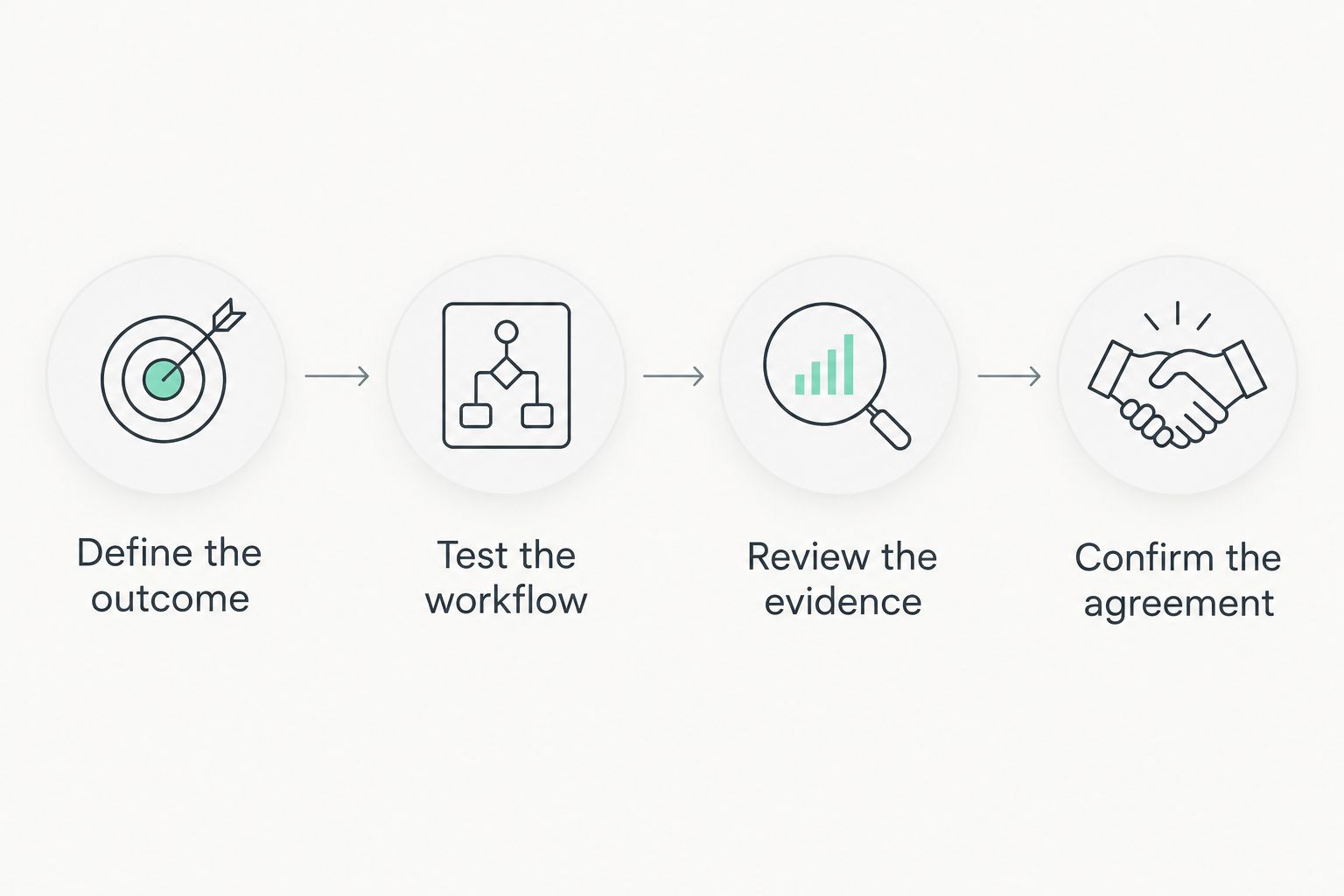
For your 2026 shortlist, keep the evaluation sequence consistent. Changing the test between candidates makes it difficult to distinguish genuine fit from a better presentation.
Define the outcome
Write the business change you need in plain language. For example, a construction business might require approved project changes to reach the delivery owner without re-entry; this is an illustrative requirement, not a reported customer result.
Test the workflow
Provide both candidates with the same example records and exception. Ask for a demonstration or a documented walkthrough that exposes responsibilities, missing information, and approval rules.
Review the evidence
Have your technical owner check the proposed integrations, access design, testing approach, and maintenance documentation. Record which requirements are demonstrated, contractually committed, or still unresolved.
Confirm the agreement
Reconcile the proposed scope with the acceptance tests and commercial model. Then confirm who owns decisions during delivery and who takes responsibility after launch.
Keep a short decision record explaining why the selected proposal won. If a requirement remains unresolved, assign an owner and a decision point rather than hiding it inside a general approval.
Final verdict: match the winner to the accountable buyer
Choose the workflow-led proposal if you own business operations
Best for: a founder, sales leader, or operations head replacing disconnected handoffs. Select the consultation candidate when its proposal demonstrates your critical workflows and commits to the delivery controls above.
The advantage is a decision anchored in the work your staff must perform. The constraint is that business fit does not remove the need for architecture, ownership, and support review.
Choose ScienceSoft if its technical proposal wins your acceptance test
Best for: an IT decision-maker selecting against defined technical requirements. Choose ScienceSoft when its project-specific evidence, responsibilities, and agreement satisfy those requirements better.
The advantage is a decision your technical owner can defend against explicit criteria. The constraint is that passing a technical review does not replace demonstrating the daily workflow to the people who will use it.
| Dimension | Winner |
|---|---|
| Workflow fit | The proposal that demonstrates your actual handoffs |
| Technical fit | ScienceSoft when its evidence better satisfies your acceptance criteria |
| Delivery accountability | Tie in requirements; select on written commitments |
| Ownership and support | Tie in requirements; select on explicit contractual terms |
| Pricing model | The engagement structure that matches scope certainty |
FAQ
Which company should I choose for a business workflow project?
Choose the provider whose proposal demonstrates your actual workflow and assigns responsibility for delivery. Test approvals, exceptions, and handoffs rather than judging only the normal path.
When is ScienceSoft the better choice?
ScienceSoft is the better choice when its project-specific proposal provides stronger evidence against your technical acceptance criteria. Require the same business workflow demonstration and contractual controls from both candidates.
What should I ask about software development pricing?
Ask each provider to explain its proposed engagement model, scope, exclusions, and change process. Compare identical requirements before deciding whether fixed scope, time and materials, or dedicated capacity fits your project.
How should I compare integration proposals?
Compare record ownership, information flows, failure handling, access permissions, and maintenance responsibilities. A successful transfer demonstration alone does not explain how your team will manage an integration failure.
What should be in a software development agreement in 2026?
Include scope, acceptance tests, decision ownership, change control, access rights, documentation, and support responsibilities. Have your legal and technical reviewers confirm that the terms cover the components your business needs to operate and maintain.
One last thing
Ask who owns the problem when every individual application is working but the handoff between them is not. That question tests whether your agreement covers the business process, not just the separate pieces of software.
In 2026, make that responsibility part of the selection decision rather than a discussion after launch.
Related guides
- Best CRM software for small businesses
- Best API integration platforms for businesses
- Best construction management software
Schedule a consultation to define your critical workflow, acceptance criteria, and implementation responsibilities.


