





Choose Hexagon IT Solutions if you run an SMB or mid-market business and want a consultation to define a sales, operations, or IT project; choose IBM if your brief centers on IBM technology and requires the company behind that technology. For your 2026 decision, separate help defining the business problem from a requirement for a specific technology provider.
- Hexagon IT Solutions vs IBM is a business-scope decision before it is a technology comparison.
- Choose the consultation-led option for an SMB project that needs a clear brief and acceptance criteria.
- Choose IBM when IBM technology is a requirement, rather than simply another option.
- Compare delivery ownership, integration responsibilities, and contract structure before selecting a provider.
Why this matters
A missed sales follow-up and an enterprise infrastructure modernization are different buying problems. Putting both into the same vendor comparison produces proposals that answer different questions.
Choose the project category before choosing the provider. A founder trying to remove duplicate data entry needs a defined workflow and accountable owner; an IT leader responsible for IBM infrastructure needs relevant product expertise and an appropriate support arrangement.
Your 2026 shortlist should reflect that distinction. Company size, name recognition, and a long feature list do not establish who will solve your particular problem.
At a glance
The consultation-led column below describes a buying route for a focused business project, not a promise about delivery speed or product functionality. Use it to shape the brief you send each provider.
| Dimension | Hexagon IT Solutions | IBM |
|---|---|---|
| Best for | SMB and mid-market buyers starting with a business consultation | Buyers whose requirements explicitly involve IBM technology |
| Starting point | Define a sales, operations, or IT problem | Establish the IBM products, services, and expertise required |
| Standout distinction | Consultation-led business discussion | Technology portfolio alongside consulting services |
| Existing systems | Evaluate the systems your workflow must connect | Strong reason to shortlist when IBM systems are central |
| Automation | Judge against a demonstrated business workflow | Judge against a demonstrated business workflow |
| Governance | Require written responsibilities and acceptance criteria | Require written responsibilities and acceptance criteria |
| Execution | Assess the proposed team, scope, and handover | Assess the proposed team, scope, and handover |
| Pricing model | Request scoped and ongoing-service terms separately | Separate relevant product, consulting, and support terms |
A consultation wins when the business problem comes first
The consultation-led option is the better starting point for an SMB buyer who has a clear operational frustration but no agreed technical brief. That is a choice about the next buying step, not a claim that one provider delivers faster.
For example, a construction operations head might need sales and project teams to stop entering the same customer information in separate places. The first task is to identify the authoritative record, the handoff, and the person responsible for exceptions—not to select a technology stack.
Bring these details to the discussion:
- Business outcome: What must become easier, faster, or more reliable?
- Current workflow: Where does work stop, repeat, or lose ownership?
- System boundary: Which applications must remain in place?
- Acceptance test: What observable result will count as completion?
The advantage is a problem-first discussion. The limitation is equally clear: a consultation is not evidence of implementation capability, so require a delivery proposal before making a larger commitment.
IBM wins when IBM technology is the requirement
IBM is the clearer choice when you need the provider behind IBM technology. IBM publishes information about its infrastructure, software, consulting, and support businesses; its 2026 product documentation and service terms are the relevant sources for a product-specific purchase.
An existing IBM environment gives your evaluation a concrete starting point. Name the products involved, the intended change, and whether you need advice, implementation, product support, or some combination.
That distinction prevents a common procurement error: treating product ownership and project delivery as the same responsibility. Your contract still needs to identify who configures systems, manages dependencies, and accepts the result.
The benefit is direct alignment with a named technology requirement. The tradeoff is that you still need to select the relevant offering and engagement scope; the IBM name alone does not define either.
IBM wins on portfolio breadth; a narrow brief needs less breadth
IBM's portfolio spans technology products and consulting services. IBM has the stronger fit when the purchase genuinely spans those categories, rather than when a broader catalog merely looks reassuring.
A wider portfolio gives an enterprise buyer more categories to evaluate within one supplier relationship. It does not establish that every category belongs in your project.
For a focused sales or operations brief, start with the smallest useful scope. You do not need to turn a customer handoff problem into an infrastructure program unless the technical assessment identifies that dependency.
Ask both candidates to distinguish:
- What the business needs now.
- What must change to support that outcome.
- What is optional.
- What belongs in a later decision.
This keeps the comparison fair. Breadth wins when breadth is required; a bounded consultation is the more useful next step when you are still defining the problem.
Neither wins automation without a working demonstration
Automation is a tie until the proposed solution completes your actual workflow. A feature presentation cannot establish whether records remain accurate, exceptions reach the right person, or the process remains understandable after handover.
For your 2026 evaluation, give each candidate the same 3 workflows: a normal transaction, an exception, and a failed handoff. These are suggested test cases, not a claim about either provider's capabilities.
A professional services firm, for example, can ask candidates to demonstrate how an inquiry becomes an assigned opportunity and how that assignment reaches the delivery team. Use sample records without customer-sensitive information.
Check the result, not the presentation:
- Did information arrive in the intended destination?
- Did the right person receive responsibility?
- Did an exception become visible?
- Can your team explain what happened?
The winner is the proposal that demonstrates your requirements and documents the boundaries. Do not award either provider an automation advantage before that demonstration.
Governance is a tie until ownership is written down
Neither provider wins governance on reputation alone. The useful evidence is the responsibility schedule attached to your engagement.
Define who approves access, changes workflows, handles incidents, maintains documentation, and authorizes releases. Separate the provider's responsibilities from your employees' responsibilities and any third-party obligations.
This matters even for a modest project. A workflow can function correctly while leaving nobody accountable for a failed connection or an incorrect permission.
Ask for written answers to these questions:
- Who owns the business process?
- Who administers the delivered system?
- Who investigates an integration failure?
- Who approves a change after launch?
- What documentation and access remain with your business?
Do not infer a certification, contractual commitment, or security control from a brand name. Evaluate the specific service and agreement you intend to purchase.
Execution belongs to the proposed team, not the company name
A provider comparison becomes useful when it reaches the people and work involved. Choose the proposal with clear delivery accountability, not an unsupported promise of speed.
Ask who leads the engagement, who makes technical decisions, and who will work with your business owner. Request relevant evidence for the proposed scope rather than accepting an unrelated example as proof.
For a 2026 project, make the handover explicit before signing. Specify the documentation, administrative access, configuration records, and training your team needs to operate the result.
Neither provider receives an automatic execution win here. A focused team can still have an unclear scope, and a large organization can still submit a well-bounded proposal; judge the actual engagement.
Use the same evaluation questions for both candidates. Otherwise, you risk comparing a detailed implementation proposal with an introductory capabilities presentation.
Pricing: compare contract structure before total commitment
Compare the commercial structure that each proposal actually offers. Do not assume either provider uses a particular model for every engagement.
A scoped project supports budget predictability when deliverables are stable; an ongoing engagement supports changing priorities when approval controls are clear. Neither structure removes the need to define what is included.
Separate these commitments in your comparison:
| Contract component | What to establish before signing |
|---|---|
| Discovery | Required outputs and the decision they support |
| Implementation | Deliverables, dependencies, exclusions, and acceptance |
| Software | Licensing responsibilities and applicable terms |
| Support | Covered work, escalation process, and responsibilities |
| Changes | Approval authority and how additional work is agreed |
| Exit | Data access, documentation, and transition obligations |
For an IBM engagement involving products and services, distinguish those commitments rather than treating them as one item. For a consultation-led project, distinguish the initial advisory work from any subsequent implementation agreement.
The strongest commercial comparison uses the same scope and acceptance standard. A smaller initial commitment is not automatically a smaller total obligation.
Use a shared brief to make the decision
Turn the comparison into a buying process. Ask both candidates to respond to the same brief, then evaluate their answers against the same criteria.
Define outcomes
Write the business result in plain language. For example, your goal might be to give sales and operations a shared view of an approved customer handoff; that is a proposed outcome, not a product claim.
Map dependencies
List the applications, records, approvals, and people involved. Identify anything your business cannot replace during the project.
Test workflows
Use the demonstration cases described above. Require the proposed solution to show both the normal path and the handling of exceptions.
Assign ownership
Name the business owner, delivery lead, and post-launch administrator. Record who decides when a requirement changes.
Agree acceptance
Write the completion test before work starts. Then review the outcome after 30 days of use as an internal management checkpoint—not as a promised delivery schedule.
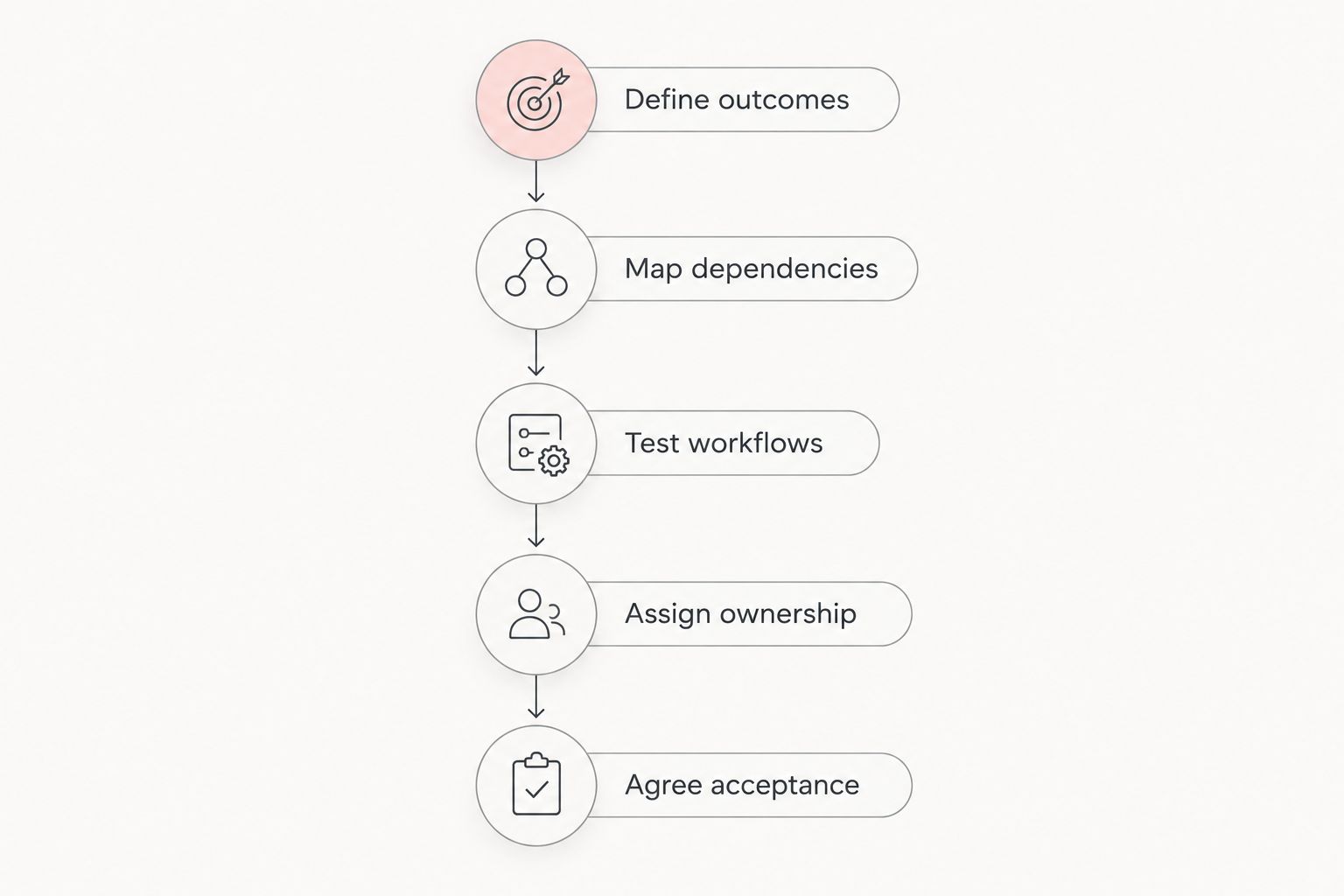
A shared brief exposes differences that a capabilities list conceals. It also gives you a basis for rejecting unnecessary scope without rejecting a provider's broader capabilities.
Final verdict: choose the requirement, then the provider
Choose the consultation-led option if you are an SMB operator
Best for: a founder, sales leader, or operations head defining a focused business project. Start with the workflow, the desired result, and the systems you must retain.
The consultation is the next move. Make any implementation decision conditional on the proposed team, relevant evidence, and a written scope.
Choose IBM if you own an IBM-centered technology requirement
Best for: an IT buyer who needs IBM products, product-specific services, or the technology provider's involvement. Specify the requirement before evaluating the engagement.
IBM is the named winner for that scenario. For a general business workflow project without an IBM dependency, keep the evaluation open and compare actual proposals.
| Dimension | Winner |
|---|---|
| Defining a focused SMB business brief | Consultation-led option |
| Requiring the IBM technology provider | IBM |
| Buying across IBM product and consulting categories | IBM |
| Demonstrating workflow automation | Tie until demonstrated |
| Establishing governance | Tie until contracted |
| Delivery execution | Decide from the proposed team and scope |
| Commercial structure | Decide from equivalent proposals |
FAQ
Which option is better for a small business?
A consultation-led option is the better starting point for a small business that needs to define a sales, operations, or IT project. Choose IBM instead when IBM technology is an explicit requirement, then evaluate the particular engagement.
Is IBM better for a company already using IBM systems?
IBM belongs on the shortlist when the project requires the company behind existing IBM technology. Specify whether you need product support, implementation, consulting, or another service before selecting the engagement.
How should I compare the commercial proposals?
Compare proposals against the same scope, deliverables, and acceptance criteria. Separate discovery, implementation, software obligations, support, changes, and exit terms so that unlike commitments do not appear equivalent.
Which provider is better for workflow automation?
Select the provider that demonstrates your workflow and documents responsibility for exceptions. Use identical sample cases to assess record accuracy, handoffs, failure handling, and administrative ownership.
What should I prepare before requesting a consultation in 2026?
Prepare a short brief containing the business outcome, current workflow, required systems, decision owner, and acceptance test. That gives each candidate a specific problem to address instead of an open-ended request for capabilities.
One last thing
Ask each candidate what your team must do after delivery. The answer should identify ongoing administration, exception handling, and decisions that remain yours.
That question makes a proposal easier to evaluate than another feature comparison. It tests whether you understand the operating commitment you are about to make.
Related guides
- IBM alternatives
- Digital transformation consulting firms
- API integration platforms for businesses
- CRM software for small businesses
Schedule a consultation with Hexagon IT Solutions to discuss your business brief.


