




Executive answer
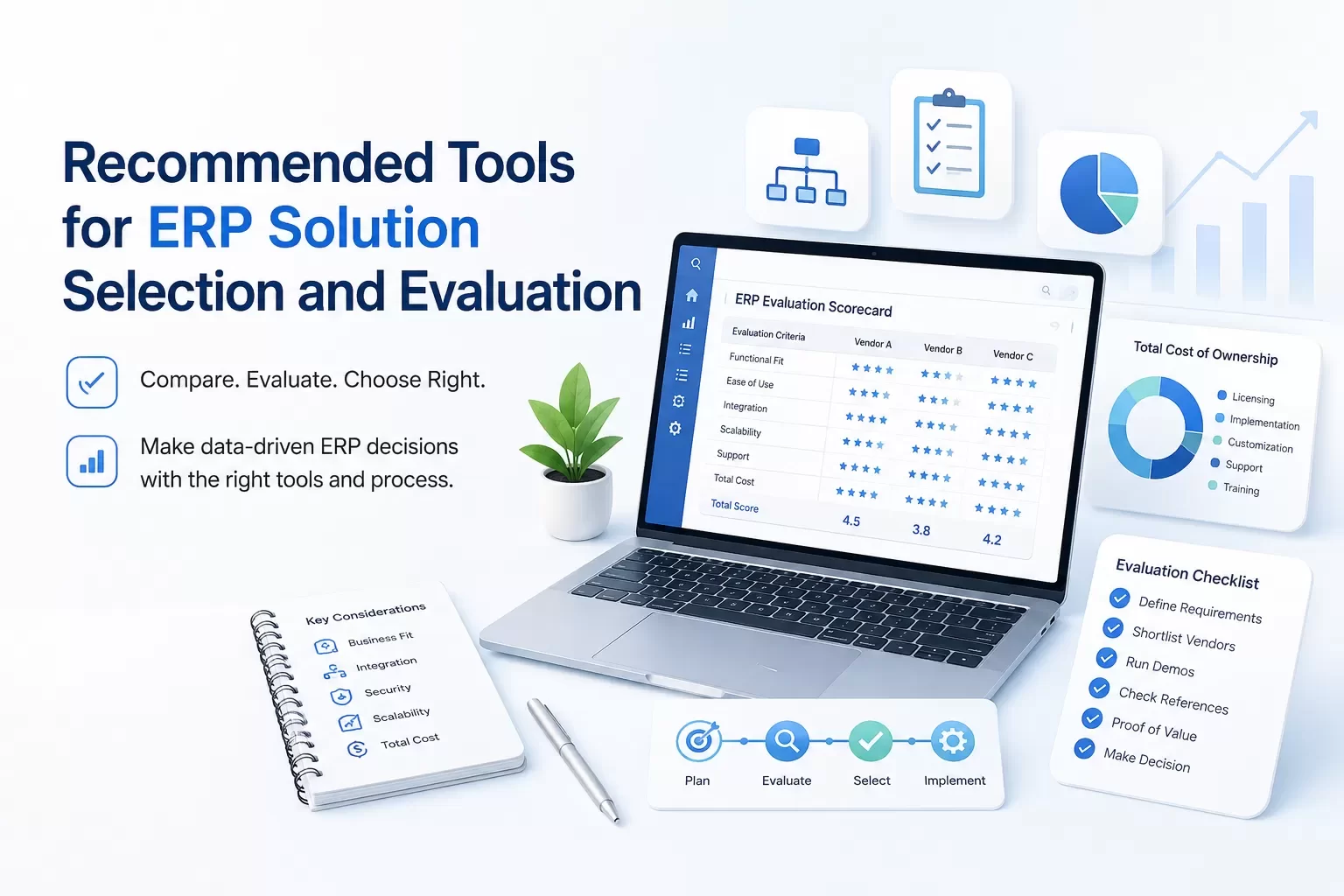
Tools support the decision; they do not replace disciplined evaluation. A weighted scorecard, scripted demonstrations, reference checks, and a realistic total-cost model matter more than a polished vendor presentation.
The phrase “best” can hide important trade-offs. In ERP solution selection, the right answer depends on the workflow being improved, the people responsible for it, the systems that must connect, the data that must remain trustworthy, and the organization’s ability to support change. This guide provides a structured way to compare the available choices and move from general research to a defensible decision.
Choose a toolchain, not a collection of subscriptions
Tools should form a connected path from planning to execution and measurement. When information is copied among unrelated products, the organization creates another version-control problem. Define the system of record for requirements, customer data, operational data, documentation, and performance metrics.
Prefer tools with clear ownership, reliable exports, appropriate access controls, useful APIs, and an adoption model the team can sustain. The most capable tool is not valuable when it is too complex for the people responsible for daily work.
Evaluation criteria for every tool
Assess functional fit, ease of use, integration, security, administration, reporting, scalability, support, and total cost. Test the highest-value workflow and the most likely exception. Ask how the tool handles permissions, audit history, failed automations, duplicate records, data retention, and offboarding.
Review pricing in the context of real usage. Per-user, per-action, per-record, storage, premium connector, and implementation charges can change the economics. Estimate a three-year cost and include the internal time needed to administer the platform.
Run a controlled proof of value
A proof of value should answer a business question, not simply prove that the software opens. Select one workflow, a small user group, representative data, and measurable before-and-after indicators. Keep the pilot long enough to expose exceptions and adoption friction.
Record configuration decisions and feedback. At the end, decide whether to proceed, adjust the design, evaluate another tool, or stop. A small disciplined test is less expensive than a company-wide rollout based on a scripted demonstration.
Governance matters after selection
Assign a product owner, technical owner, data owner, and process owner. Establish how changes are requested, tested, approved, documented, and released. Monitor adoption and workflow outcomes, not only uptime.
Review the toolset periodically for overlap. Redundant systems create cost, fragmented data, and uncertain accountability. Consolidation is useful when it simplifies the user journey without removing a capability the business genuinely needs.
The main options to consider
1. Requirements and scoring: Excel, Google Sheets, Airtable, or a procurement platform
Requirements and scoring: Excel, Google Sheets, Airtable, or a procurement platform can be a strong part of a ERP solution selection program when it solves a clearly defined job and connects cleanly with the rest of the operating environment. Evaluate it using a real workflow, representative users, and realistic data rather than relying only on a feature checklist.
Confirm licensing, permissions, integration limits, reporting, administration effort, support, portability, and the cost of future changes. The right choice should reduce friction for users while giving leaders better control and visibility.
2. Process mapping: Lucidchart, Miro, Visio, or FigJam
Process mapping: Lucidchart, Miro, Visio, or FigJam can be a strong part of a ERP solution selection program when it solves a clearly defined job and connects cleanly with the rest of the operating environment. Evaluate it using a real workflow, representative users, and realistic data rather than relying only on a feature checklist.
Confirm licensing, permissions, integration limits, reporting, administration effort, support, portability, and the cost of future changes. The right choice should reduce friction for users while giving leaders better control and visibility.
3. Candidate platforms: Microsoft Dynamics 365 Business Central, Oracle NetSuite, SAP, Acumatica, or Odoo
Candidate platforms: Microsoft Dynamics 365 Business Central, Oracle NetSuite, SAP, Acumatica, or Odoo can be a strong part of a ERP solution selection program when it solves a clearly defined job and connects cleanly with the rest of the operating environment. Evaluate it using a real workflow, representative users, and realistic data rather than relying only on a feature checklist.
Confirm licensing, permissions, integration limits, reporting, administration effort, support, portability, and the cost of future changes. The right choice should reduce friction for users while giving leaders better control and visibility.
4. Data discovery: SQL tools, data catalogs, and profiling utilities
Data discovery: SQL tools, data catalogs, and profiling utilities can be a strong part of a ERP solution selection program when it solves a clearly defined job and connects cleanly with the rest of the operating environment. Evaluate it using a real workflow, representative users, and realistic data rather than relying only on a feature checklist.
Confirm licensing, permissions, integration limits, reporting, administration effort, support, portability, and the cost of future changes. The right choice should reduce friction for users while giving leaders better control and visibility.
5. Integration assessment: Postman, API documentation tools, and middleware platforms
Integration assessment: Postman, API documentation tools, and middleware platforms can be a strong part of a ERP solution selection program when it solves a clearly defined job and connects cleanly with the rest of the operating environment. Evaluate it using a real workflow, representative users, and realistic data rather than relying only on a feature checklist.
Confirm licensing, permissions, integration limits, reporting, administration effort, support, portability, and the cost of future changes. The right choice should reduce friction for users while giving leaders better control and visibility.
6. Project and decision tracking: Jira, ClickUp, Asana, or Monday.com
Project and decision tracking: Jira, ClickUp, Asana, or Monday.com can be a strong part of a ERP solution selection program when it solves a clearly defined job and connects cleanly with the rest of the operating environment. Evaluate it using a real workflow, representative users, and realistic data rather than relying only on a feature checklist.
Confirm licensing, permissions, integration limits, reporting, administration effort, support, portability, and the cost of future changes. The right choice should reduce friction for users while giving leaders better control and visibility.
7. Reporting validation: Power BI, Tableau, or the ERP’s native analytics
Reporting validation: Power BI, Tableau, or the ERP’s native analytics can be a strong part of a ERP solution selection program when it solves a clearly defined job and connects cleanly with the rest of the operating environment. Evaluate it using a real workflow, representative users, and realistic data rather than relying only on a feature checklist.
Confirm licensing, permissions, integration limits, reporting, administration effort, support, portability, and the cost of future changes. The right choice should reduce friction for users while giving leaders better control and visibility.
A decision framework you can use
Business fit: Does it support the critical workflow, decisions, roles, and exceptions without excessive workarounds?
User adoption: Can the people doing the work understand and use it consistently with reasonable training?
Integration: Can it exchange reliable data with the systems that must remain?
Data and reporting: Will leaders have trustworthy records, definitions, dashboards, and audit history?
Security and control: Are permissions, identity, logging, backup, retention, and compliance needs addressed?
Total cost: What will licensing, implementation, migration, integration, support, administration, and future change cost?
Scalability: Can the approach support more users, transactions, workflows, locations, and reporting needs?
Maintainability: Who will own configuration, documentation, testing, releases, and vendor management?
Build the business case
Connect the investment to a baseline and a target. Useful measures may include response time, cycle time, conversion rate, rework, hours of manual entry, error rate, forecast accuracy, time to prepare a quote, approval delay, customer effort, support burden, or revenue leakage. Identify which measures the proposed change can reasonably influence.
Separate hard financial benefits from capacity, risk, experience, and decision-quality benefits. Document assumptions and name the owner of each measure. A credible business case is transparent about uncertainty and includes the cost of adoption, governance, and continued improvement.
Plan implementation before making the final choice
Define the first release, migration boundary, integration sequence, training plan, support model, and acceptance criteria before selection is complete. This exposes hidden dependencies early. Assign accountable owners on both the business and technical sides, and confirm what the vendor or delivery partner will provide.
Use a phased rollout when possible. Start with a coherent workflow that delivers value, learn from actual use, and then expand. Protect the scope from uncontrolled additions, but maintain a prioritized backlog so valid improvements are not lost.
Where Arches CRM fits
Arches CRM is not a replacement for every custom application or full ERP. It can serve as the customer and sales workflow layer when the business needs connected lead management, communications, pipelines, estimates, proposals, e-signatures, and follow-up. Custom software or ERP components may still be appropriate for specialized operations, manufacturing, finance, or industry-specific work.
The architectural question is where each responsibility belongs. Keeping customer-facing sales activity in a CRM and integrating it with purpose-built operational systems can be more maintainable than forcing one platform to perform every function.
Practical next step: Map one lead-to-signed-contract workflow and identify every handoff, duplicate entry, delay, and missing decision point. Use that map to decide what belongs in the CRM and what should remain connected elsewhere.
Frequently Asked Questions
What is the first step in ERP solution selection?
Define the business outcome and map the current workflow before evaluating products or partners. Include users, systems, handoffs, exceptions, data, and measurable success criteria.
How do I choose the best ERP solution selection approach?
Compare a short list using the same critical scenarios and weighted criteria. Consider business fit, adoption, integration, security, total cost, scalability, and long-term ownership.
Should price be the main selection factor?
No. Price matters, but a low initial quote can become expensive when migration, integration, workarounds, administration, support, and future changes are included. Use a multi-year total-cost view.
How long should evaluation take?
It depends on scope and risk. A focused small-business decision may take weeks, while an enterprise or regulated program may take months. Do not compress data, security, integration, and ownership checks merely to meet an arbitrary date.
What should be included in a pilot?
Use a real end-to-end workflow, representative users, realistic data, common exceptions, reporting, permissions, and integrations. Define success measures and a clear decision at the end.
How can we improve user adoption?
Involve users early, simplify the workflow, explain what changes and why, train by role, provide accessible support, and measure actual use. Leadership should reinforce the new process consistently.
When is customization justified?
Customization is justified when it supports a differentiating or essential workflow that configuration cannot handle responsibly. Avoid customization that simply preserves unnecessary habits from the old process.
How often should the solution be reviewed?
Review adoption and business outcomes frequently after launch, then establish quarterly or semiannual governance reviews for performance, enhancement priorities, security, cost, and system overlap.
Conclusion
The best ERP solution selection decision is not determined by popularity alone. It comes from understanding the work, testing realistic scenarios, comparing total cost and risk, and choosing an approach the organization can operate well.
If your immediate challenge is a disconnected sales journey—leads in one place, communication in another, quotes in spreadsheets, and signatures in email—Arches CRM can be evaluated as a connected lead-to-signed-contract platform. Book a CRM workflow audit or start a 7-day trial to test the fit using your real process.


