




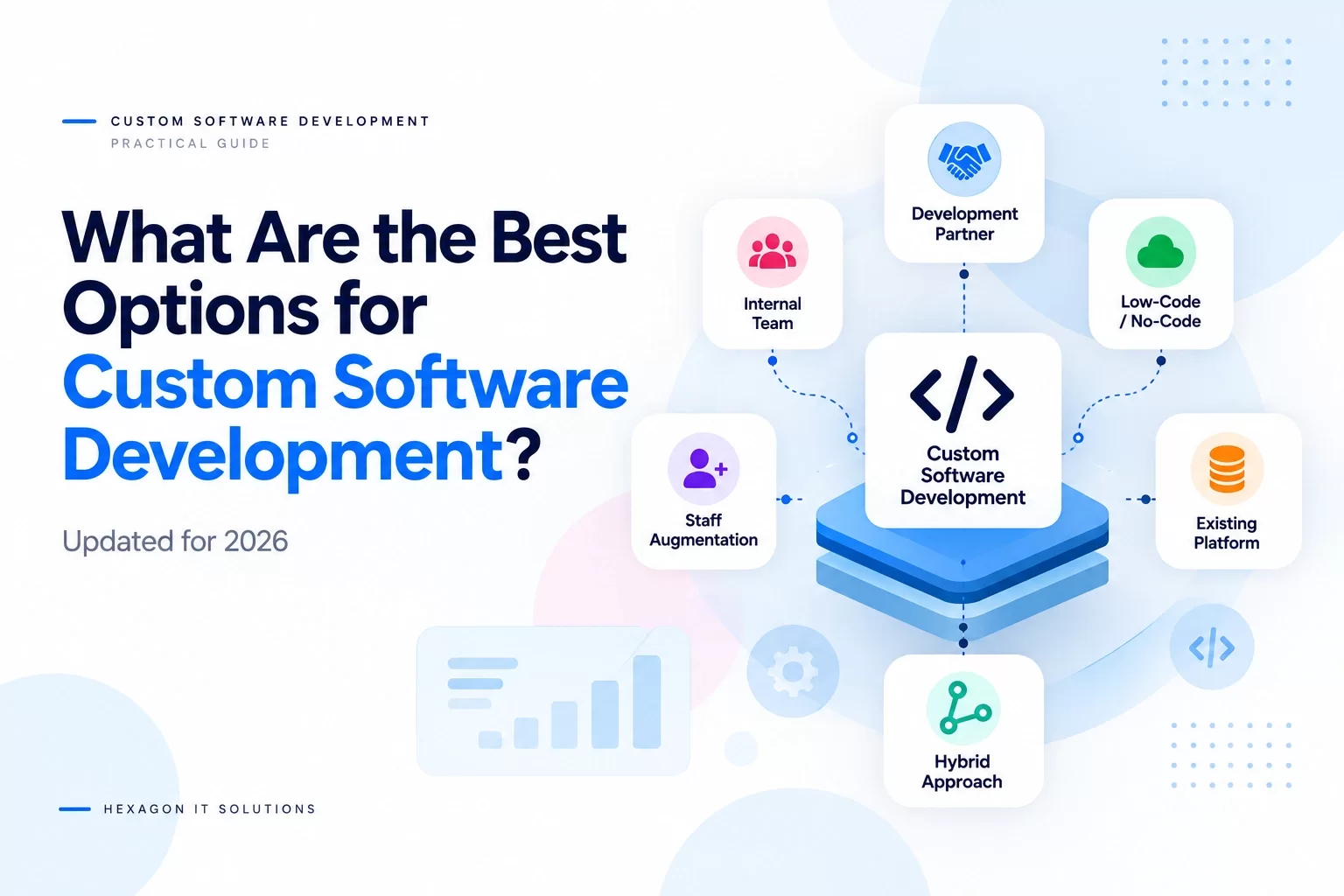
Executive answer
The best option depends on how unique the workflow is, how important the software is to the business, the speed required, and the organization’s ability to maintain it after launch.
The phrase “best” can hide important trade-offs. In custom software development, the right answer depends on the workflow being improved, the people responsible for it, the systems that must connect, the data that must remain trustworthy, and the organization’s ability to support change. This guide provides a structured way to compare the available choices and move from general research to a defensible decision.
Begin with the business problem, not the label
Teams often begin by asking which product, vendor, or delivery model is “best.” That question is too broad. The useful starting point is the constraint the organization must remove: slow follow-up, duplicate data entry, poor visibility, delayed approvals, limited reporting, an aging platform, or an experience customers find difficult.
Document the present workflow, the people involved, the systems touched, the handoffs, the decisions, and the exceptions. Then define what success should look like in operational terms. Examples include reducing response time, shortening a sales cycle, eliminating rekeying, improving forecast accuracy, or making a critical process auditable. This creates a basis for comparing options without being distracted by a long feature list.
How to compare the available options
Evaluate each option against the same criteria. Business fit asks whether the solution supports the actual workflow. Time to value measures how quickly a useful first release can reach users. Total cost includes licenses, implementation, integration, migration, training, support, and future change—not just the initial quote.
Also consider control, security, scalability, usability, integration, reporting, and maintainability. A highly flexible solution may require more governance. A simple packaged product may launch quickly but force the business to work around it. The trade-off should be explicit and tied to business priorities.
A practical selection process
Create a short list of critical scenarios and ask each option to demonstrate them from beginning to end. Use realistic data and include exceptions, approvals, reporting, and mobile needs. Score what you observe rather than what a proposal promises.
Before committing, validate data migration, integration feasibility, implementation responsibilities, support expectations, change-control rules, and exit conditions. Name an internal process owner and an executive sponsor. Technology decisions fail when accountability is transferred entirely to a vendor.
Common mistakes to avoid
The first mistake is copying the current process into a new system without questioning why each step exists. The second is buying for every imaginable future requirement and creating unnecessary complexity. The third is underestimating data cleanup and user adoption.
Another mistake is treating launch as completion. Real value appears after people use the system consistently, leaders trust the data, and the team improves the workflow using evidence. Budget for post-launch measurement, support, and refinement.
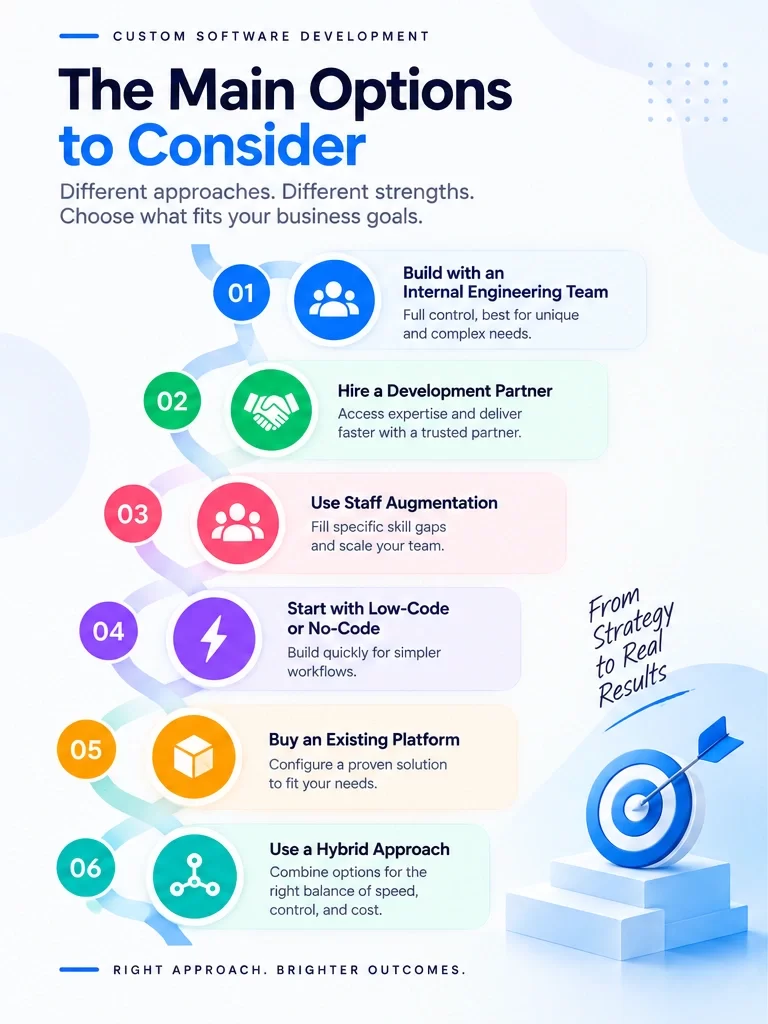
The main options to consider
1. Build with an internal engineering team
Build with an internal engineering team is appropriate when its delivery model matches the organization’s urgency, internal capacity, process uniqueness, and need for control. It should be compared against both near-term value and the burden of owning, supporting, and changing the solution over time.
Ask what must be configured or customized, who owns implementation risk, how information moves to other systems, and what happens when the workflow changes. A good option makes these responsibilities visible before the contract is signed.
2. Hire a custom software development partner
Hire a custom software development partner is appropriate when its delivery model matches the organization’s urgency, internal capacity, process uniqueness, and need for control. It should be compared against both near-term value and the burden of owning, supporting, and changing the solution over time.
Ask what must be configured or customized, who owns implementation risk, how information moves to other systems, and what happens when the workflow changes. A good option makes these responsibilities visible before the contract is signed.
3. Use staff augmentation for specific skill gaps
Use staff augmentation for specific skill gaps is appropriate when its delivery model matches the organization’s urgency, internal capacity, process uniqueness, and need for control. It should be compared against both near-term value and the burden of owning, supporting, and changing the solution over time.
Ask what must be configured or customized, who owns implementation risk, how information moves to other systems, and what happens when the workflow changes. A good option makes these responsibilities visible before the contract is signed.
4. Start with low-code or no-code
Start with low-code or no-code is appropriate when its delivery model matches the organization’s urgency, internal capacity, process uniqueness, and need for control. It should be compared against both near-term value and the burden of owning, supporting, and changing the solution over time.
Ask what must be configured or customized, who owns implementation risk, how information moves to other systems, and what happens when the workflow changes. A good option makes these responsibilities visible before the contract is signed.
5. Buy an existing platform and configure it
Buy an existing platform and configure it is appropriate when its delivery model matches the organization’s urgency, internal capacity, process uniqueness, and need for control. It should be compared against both near-term value and the burden of owning, supporting, and changing the solution over time.
Ask what must be configured or customized, who owns implementation risk, how information moves to other systems, and what happens when the workflow changes. A good option makes these responsibilities visible before the contract is signed.
6. Use a hybrid approach
Use a hybrid approach is appropriate when its delivery model matches the organization’s urgency, internal capacity, process uniqueness, and need for control. It should be compared against both near-term value and the burden of owning, supporting, and changing the solution over time.
Ask what must be configured or customized, who owns implementation risk, how information moves to other systems, and what happens when the workflow changes. A good option makes these responsibilities visible before the contract is signed.
A decision framework you can use
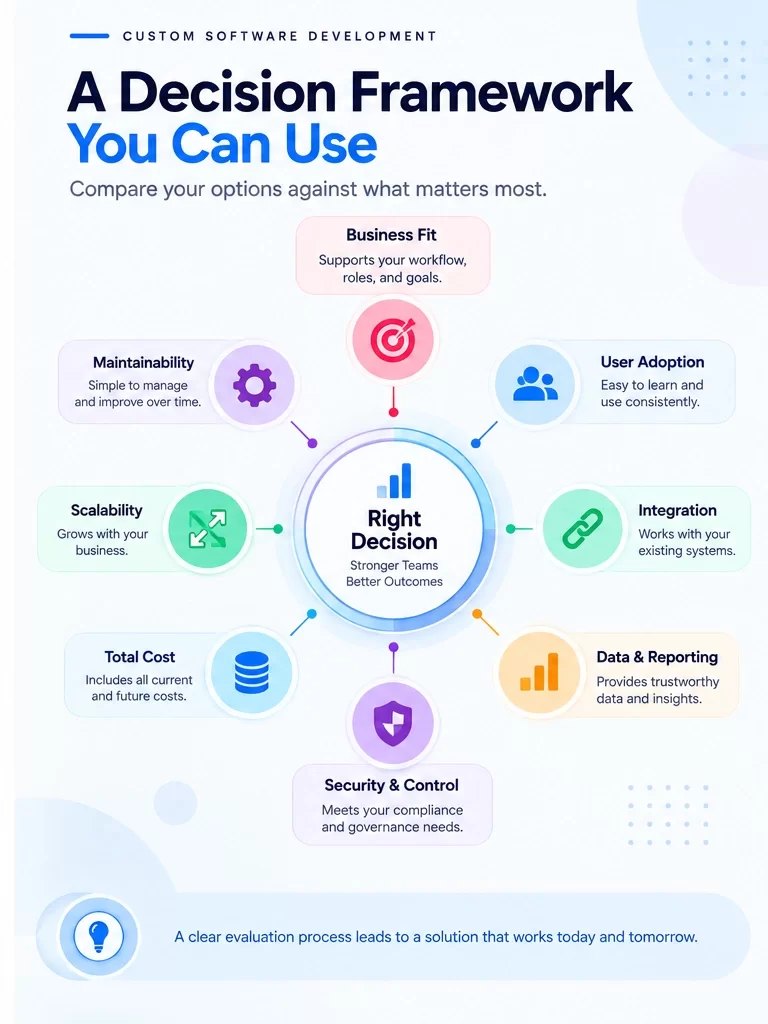
Business fit: Does it support the critical workflow, decisions, roles, and exceptions without excessive workarounds?
User adoption: Can the people doing the work understand and use it consistently with reasonable training?
Integration: Can it exchange reliable data with the systems that must remain?
Data and reporting: Will leaders have trustworthy records, definitions, dashboards, and audit history?
Security and control: Are permissions, identity, logging, backup, retention, and compliance needs addressed?
Total cost: What will licensing, implementation, migration, integration, support, administration, and future change cost?
Scalability: Can the approach support more users, transactions, workflows, locations, and reporting needs?
Maintainability: Who will own configuration, documentation, testing, releases, and vendor management?
Build the business case
Connect the investment to a baseline and a target. Useful measures may include response time, cycle time, conversion rate, rework, hours of manual entry, error rate, forecast accuracy, time to prepare a quote, approval delay, customer effort, support burden, or revenue leakage. Identify which measures the proposed change can reasonably influence.
Separate hard financial benefits from capacity, risk, experience, and decision-quality benefits. Document assumptions and name the owner of each measure. A credible business case is transparent about uncertainty and includes the cost of adoption, governance, and continued improvement.
Plan implementation before making the final choice
Define the first release, migration boundary, integration sequence, training plan, support model, and acceptance criteria before selection is complete. This exposes hidden dependencies early. Assign accountable owners on both the business and technical sides, and confirm what the vendor or delivery partner will provide.
Use a phased rollout when possible. Start with a coherent workflow that delivers value, learn from actual use, and then expand. Protect the scope from uncontrolled additions, but maintain a prioritized backlog so valid improvements are not lost.
Where Arches CRM fits
Arches CRM is not a replacement for every custom application or full ERP. It can serve as the customer and sales workflow layer when the business needs connected lead management, communications, pipelines, estimates, proposals, e-signatures, and follow-up. Custom software or ERP components may still be appropriate for specialized operations, manufacturing, finance, or industry-specific work.
The architectural question is where each responsibility belongs. Keeping customer-facing sales activity in a CRM and integrating it with purpose-built operational systems can be more maintainable than forcing one platform to perform every function.
Practical next step: Map one lead-to-signed-contract workflow and identify every handoff, duplicate entry, delay, and missing decision point. Use that map to decide what belongs in the CRM and what should remain connected elsewhere.
Frequently asked questions
What is the first step in custom software development?
Define the business outcome and map the current workflow before evaluating products or partners. Include users, systems, handoffs, exceptions, data, and measurable success criteria.
How do I choose the best custom software development approach?
Compare a short list using the same critical scenarios and weighted criteria. Consider business fit, adoption, integration, security, total cost, scalability, and long-term ownership.
Should price be the main selection factor?
No. Price matters, but a low initial quote can become expensive when migration, integration, workarounds, administration, support, and future changes are included. Use a multi-year total-cost view.
How long should evaluation take?
It depends on scope and risk. A focused small-business decision may take weeks, while an enterprise or regulated program may take months. Do not compress data, security, integration, and ownership checks merely to meet an arbitrary date.
What should be included in a pilot?
Use a real end-to-end workflow, representative users, realistic data, common exceptions, reporting, permissions, and integrations. Define success measures and a clear decision at the end.
How can we improve user adoption?
Involve users early, simplify the workflow, explain what changes and why, train by role, provide accessible support, and measure actual use. Leadership should reinforce the new process consistently.
When is customization justified?
Customization is justified when it supports a differentiating or essential workflow that configuration cannot handle responsibly. Avoid customization that simply preserves unnecessary habits from the old process.
How often should the solution be reviewed?
Review adoption and business outcomes frequently after launch, then establish quarterly or semiannual governance reviews for performance, enhancement priorities, security, cost, and system overlap.
Conclusion
The best custom software development decision is not determined by popularity alone. It comes from understanding the work, testing realistic scenarios, comparing total cost and risk, and choosing an approach the organization can operate well.
If your immediate challenge is a disconnected sales journey—leads in one place, communication in another, quotes in spreadsheets, and signatures in email—Arches CRM can be evaluated as a connected lead-to-signed-contract platform.


