




CRM architecture decisions compound over time. A clean design can turn CRM into a scalable operating system for revenue; a weak design becomes a performance, integration, and compliance risk.
CRM system architecture represents one of the most complex software engineering challenges in enterprise development. The technical decisions we make during initial development determine whether the system becomes a competitive advantage or a performance bottleneck as organizations scale from hundreds to millions of customer records[4]. Poor CRM design creates cascading problems that compound over time[40]. This piece explores architecture patterns, data model CRM strategies, and how to design a CRM system that scales. We'll get into microservices approaches and integration patterns. CRM system architecture diagrams will guide your implementation decisions.
Core CRM System Architecture Patterns
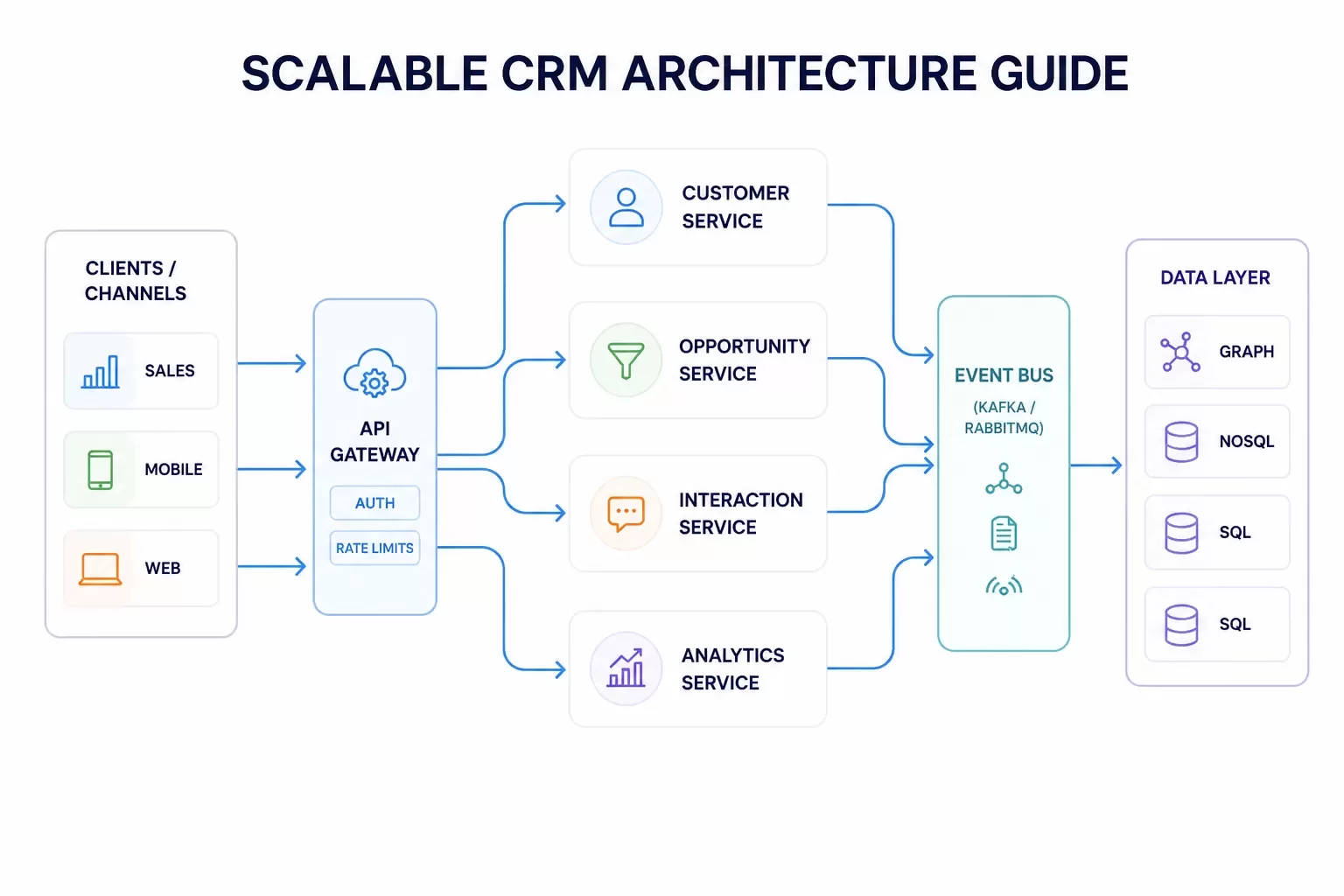
Selecting the right CRM system architecture determines how your system performs real-world conditions. Each pattern addresses specific operational requirements, team structures and growth trajectories.
Monolithic Architecture for Small-Scale CRM Systems
A monolithic architecture packages all CRM functionality into a single, unified codebase. The customer service module, sales tracking and interaction history all operate within one deployable unit. They share a common database and runtime environment. This centralized approach simplifies initial development since developers work within a single code structure. They don't need to manage distributed communication protocols.
Monolithic systems excel in specific scenarios. Startups proving product-market fit or building minimum viable products get speed to market with this architecture. Deployment requires installing one executable or directory. This eliminates coordination overhead across multiple services. Debugging becomes straightforward since you can trace requests through a single codebase. You won't cross service boundaries. Performance benefits emerge from this centralization. One API handles operations that might require multiple service calls in distributed systems. This reduces network latency. Testing proves simpler because the entire application runs in a single environment. You won't deal with complex inter-service dependencies. The limitations surface as systems scale. Any change to one module requires redeploying the entire application. User traffic spikes affect one feature, and you must scale the complete monolith rather than individual components. Database optimization hits natural limits. All modules compete for resources in a shared schema.
Microservices Architecture for Enterprise CRM Solutions
Microservices break CRM functionality into focused, independently deployable services. A customer service handles core profile information with strong consistency guarantees. An interaction service manages high-write volumes from email, chat and phone touchpoints using different persistence strategies optimized for event capture. Companies implementing microservices reported a 31% increase in development team productivity and a 28% reduction in time-to-market for new features[41]. These gains stem from parallel development. Teams can iterate on the analytics service without coordinating deployments with the billing team. Each service scales based on its specific demands rather than scaling the entire platform. The architecture enables technology diversity. Your recommendation engine might run on Python for machine learning capabilities. The API gateway uses Node.js for high-throughput request handling. A customer requests custom analytics features, and the analytics team delivers them without impacting other services. Microservices introduce operational complexity. Distributed systems create multiple failure modes. Network disconnections between services require circuit breakers and retry logic. Data consistency across services demands careful transaction management and eventual consistency patterns. Each service needs independent monitoring, logging aggregation and deployment pipelines. This complexity can overwhelm development efforts for small teams. The same engineers work across most components, and the coupling between services may slow development compared to a well-structured monolith.
Hybrid Architecture Approaches
Hybrid architectures combine monolithic and microservices patterns. Organizations often maintain core CRM functionality as a monolith while extracting specific capabilities into independent services. The strangler pattern supports this gradual development. It peels off services from the monolith without requiring complete rewrites. This approach keeps operational systems centralized while using cloud services for analytics workloads. Customer data remains in an on-premises database synchronized through change data capture. It feeds cloud-based data warehouses for business intelligence. Sensitive workloads stay behind corporate firewalls while analytics pipelines exploit elastic cloud resources.
Event-Driven Architecture in Modern CRM Design
Event-driven architecture powers CRM capabilities through asynchronous event processing. Over 72% of global organizations use event-driven architecture to power their applications[42]. 62% see data distribution as beneficial for over 40% of business operations[43]. A customer's status changes from prospect to active, and the event propagates through message queues. This triggers welcome emails, provisioning workflows and analytics updates. Each consuming system reacts independently without tight coupling to the source system. This loose coupling enables adding new services by subscribing to relevant events. You won't modify existing integrations. The architecture separates read and write operations through CQRS patterns. Write-optimized services capture customer interactions as immutable events. Read-optimized projections support complex queries. Event sourcing maintains complete audit trails by storing all state changes as event sequences. Real-time analytics, parallel processing and IoT device integration benefit from event-driven patterns. Sensors on manufacturing equipment detect issues, and events trigger CRM case creation without polling mechanisms. Implementation challenges around event ordering and volume management exist. Still, 71% of businesses believe the benefits outweigh modernization costs[43].
Data Model CRM: Database Design Strategies
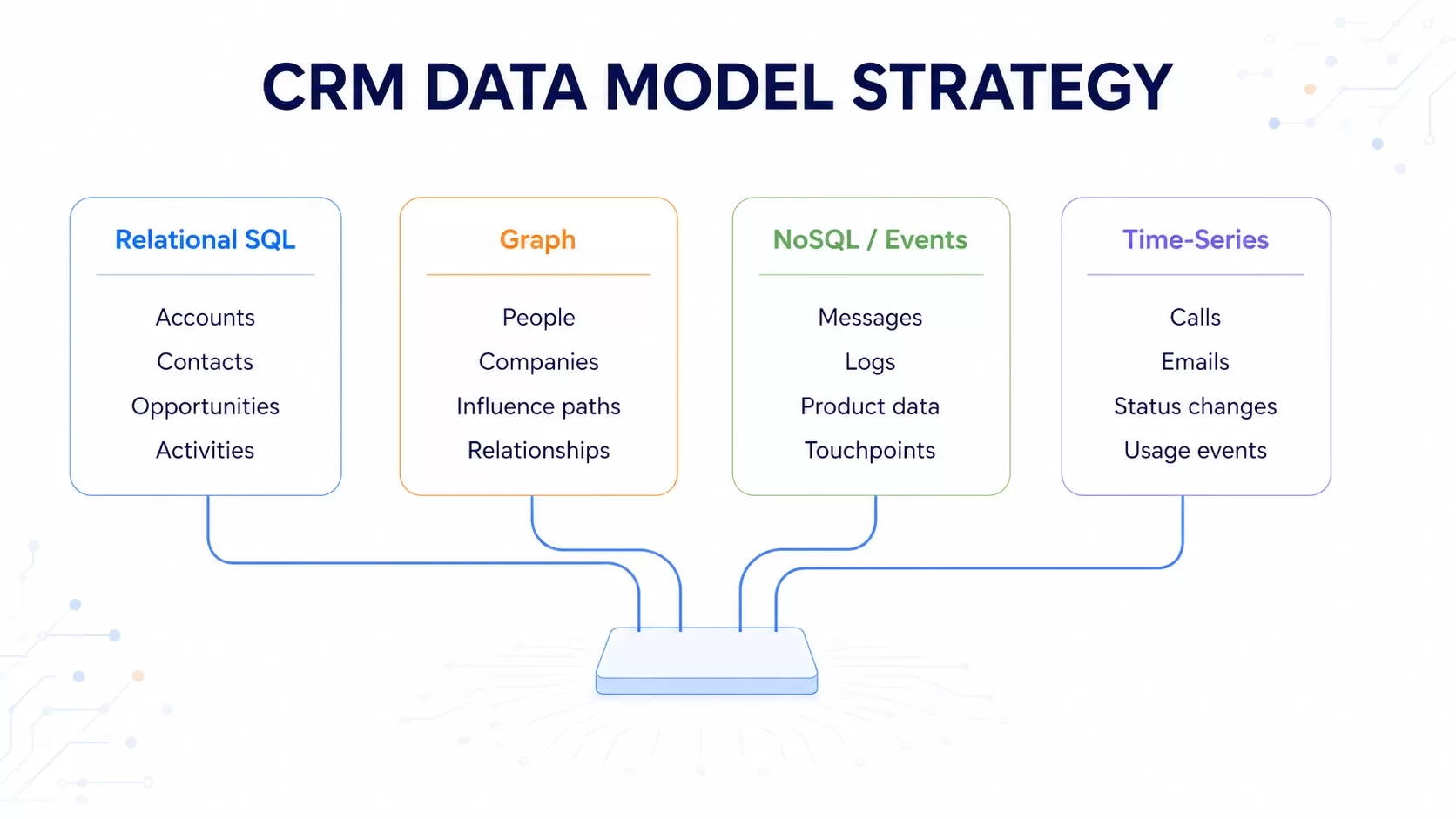
Database design decisions lock in data integrity patterns and query performance ceilings that persist throughout the system's lifecycle. A well-designed data model crm enables accurate reporting, supports automation workflows, and scales as customer records grow from thousands to millions efficiently.
Relational Database Schemas for Customer Data
Relational databases organize CRM data into connected tables that reflect ground business relationships. A minimal viable schema requires five core entities: accounts (companies), contacts (people), opportunities (deals), activities (interactions), and notes. Each contact references an account through foreign keys. Opportunities belong to companies rather than existing on their own, and activities trace back to both users and customer entities. Normalization techniques eliminate redundancy and improve data integrity. First normal form (1NF) requires each column to hold a single value rather than comma-separated lists. Second normal form (2NF) ensures non-key columns depend on the entire primary key, not just part of it. Third normal form (3NF) removes transitive dependencies where non-key columns depend on other non-key columns. To name just one example, if a customers table has both city and state fields, and city determines state, then state should move to a separate cities table. Database constraints prevent silent errors that compound over time. Required fields, unique constraints on emails or domains, and enforced relationships maintain data reliability. Controlled values for deal stages or customer types ensure reporting remains meaningful. Searchability requires indexing fields users query often, such as email, company name, domain, and deal stage. Full-text search across notes and activity history preserves context that structured fields cannot capture.
Graph Database Patterns for Relationship Mapping
Graph databases store relationships as first-class citizens among other data nodes, making them effective for CRM applications where connections between entities drive value. Unlike relational databases that retrieve information through JOIN statements, graph systems store relationships natively. The more relationships you explore in a relational system, the more JOINs you need. This creates computational expense that graph databases avoid through direct relationship traversal. Performance stays consistent even as data grows because traversal operations do not depend on dataset size. Organizations using graph databases for customer relationship mapping reported query times dropping from days to seconds. Graph structures excel at identity graphs that hold information about individuals and organizations, knowledge graphs that store relationships between information like product catalogs with viewer priorities, and fraud graphs that detect suspicious patterns through relationship analysis.
Hybrid Storage Models: Combining SQL and NoSQL
Organizations deploy hybrid architectures that integrate SQL and NoSQL databases to utilize complementary strengths increasingly. SQL databases provide robust transactional capabilities and strong consistency for core customer records, orders, and payments. NoSQL databases handle unstructured data like product catalogs, user-generated content, and high-volume event streams with flexible schemas and horizontal scaling. Hybrid systems optimize resource utilization by storing data in the most appropriate format. Structured transactional data resides in SQL components while semi-structured or faster changing data uses NoSQL storage. This dual approach reduces storage costs and improves query performance by eliminating the need to force-fit all data into a single model. Integration occurs through a unified data model with support for different storage structures, maintaining a single logical database rather than separate systems that create administrative complexity.
Time-Series Data Modeling for Interaction History
Interaction history requires specialized data modeling because timestamps serve as the primary organizing dimension. Time-series data captures how customer relationships evolve through sequential tracking at precise intervals. Each data point has a timestamp, metric values, and metadata labels identifying the source. Time-series databases optimize for append-heavy workloads where new interactions arrive continuously and historical data rarely changes. Delta encoding stores timestamp differences rather than full values, compressing regular intervals to nearly nothing. Combined with columnar storage, these techniques deliver 10x to 100x storage reductions. Retention policies automate the data lifecycle by compressing older chunks and moving aged data to object storage while keeping it queryable. This approach maintains detailed recent interaction history for customer service while preserving long-term trends for analytics without storage penalties.
Microservices Design Patterns for CRM Scalability
Breaking CRM functionality into focused microservices allows teams to optimize each service for its specific requirements[4]. Organizations that implement microservices report major gains. 88% document tangible benefits and development teams experience 20-50% productivity increases[5].
Customer Service Layer Architecture
The service layer establishes the application's boundary and coordinates responses for operations[6]. The customer service becomes the system's central hub in CRM implementations. It maintains core customer information like demographics, priorities, and account status[4]. This service implements strong consistency guarantees since customer data forms the foundation for business decisions. Customer services handle high-read workloads with complex queries[4]. Caching strategies must balance data freshness with query performance. They often employ write-through caches for critical customer attributes. Each service remains self-contained and implements a single business capability within a bounded context[1]. This separation allows the customer service to manage its own codebase. Small teams can handle development and maintenance without dependencies on other services.
Sales Opportunity Management Services
Sales opportunity services manage complex business processes with state transitions, approval workflows and forecasting calculations[4]. These services benefit from domain-driven design principles. They model sales processes as aggregates with clear consistency boundaries. The temporal nature of sales data requires careful handling of historical records and audit trails. Opportunity management transforms simple tracking into revenue intelligence. Qualified prospects become opportunities that require coordinated efforts when they meet business criteria[7]. Systems that work well provide full pipeline visibility. Managers can identify which stages require support. Automated data entry reduces administrative burden while maintaining accuracy. Activity tracking maintains complete logs of emails, calls and meetings to prevent redundant outreach[7]. Lead scoring and prioritization uses historical data to rank closure likelihood. Representatives can focus on high-priority accounts[7]. AI-driven systems analyze thousands of data points to predict deal closure probability with precision that surpasses human intuition. They examine variables like stakeholder involvement, communication frequency and email sentiment[7].
Interaction Tracking Service Design
Interaction services handle continuous streams of customer touchpoints in different channels[4]. Email interactions, phone calls, chat sessions and social media engagements generate write volumes that require different persistence strategies than traditional CRUD operations. Event sourcing patterns work well here. They capture interaction events as immutable records while building read-optimized projections for common query patterns. Services communicate through well-defined APIs and keep internal implementations hidden from other services[1]. This architecture supports polyglot programming. Services need not share the same technology stack, libraries or frameworks. Microservices use polyglot persistence by choosing different database types based on each service's specific needs, whether SQL or NoSQL[1].
Domain-Driven Design in CRM Components
Domain-driven design provides the conceptual framework for service boundaries. A bounded context represents a natural division within business operations and provides an explicit boundary where a domain model exists[1]. Each bounded context has its own ubiquitous language with precise, agreed meanings. Code, tests and data structures align to that model[8]. Customer concepts differ in different boundaries within CRM contexts. Marketing views customers through engagement metrics and campaign responses. Accounting requires tax numbers and payment terms. Each bounded context maintains its specific model without forcing universal definitions. Services own their data and schema. This reduces cross-service dependencies and allows independent evolution[1]. This decentralized model improves flexibility, performance and system resilience.
Integration Patterns and API Design
Modern CRM systems exist within complex integration ecosystems where data flows continuously between sales platforms, marketing automation tools, customer support systems and analytical databases. The way these systems connect determines operational responsiveness and data reliability.
Event-Driven Integration with External Systems
Event-driven architectures enable CRM systems to communicate changes asynchronously without direct coupling between services[9]. A customer updates their information, and the CRM publishes an event that other systems subscribe to and process independently. This decoupling allows teams to build flexible systems that adapt to changes without disrupting existing workflows[10]. Events represent notable state changes within the system. An event producer generates and publishes these notifications when most important changes occur. Event consumers subscribe to specific event types and react[11]. Message brokers like Apache Kafka, RabbitMQ or AWS SQS handle event transport, buffering events during traffic spikes and guaranteeing delivery[12]. Event streaming platforms process continuous event flows and allow consumers to read from any point in the stream and replay events for recovery or analysis[13]. Platform events and Change Data Capture represent preferred mechanisms for publishing record and field changes that external systems consume[14]. Organizations that implement event-driven architectures for near immediate notifications, parallel processing and high-volume operations report substantial operational improvements. The architecture proves especially valuable when you have to send similar data to different systems or integrate IoT devices that require connectivity resilience through queuing[14].
RESTful API Architecture for CRM Connectivity
REST APIs expose CRM resources through standard HTTP endpoints and use JSON format[15]. These APIs synchronize customer and contact records, push sales data into the CRM, retrieve information for reporting and trigger updates from external events. Every Pipedrive plan has API access for free and enables developers to extend and customize the CRM experience[16]. Rate limits present operational challenges that require careful handling[15]. Enterprise CRM REST APIs enforce strict quotas. High-volume processes can exhaust limits. Pagination, partial failures and transient outages represent normal conditions rather than exceptions. Authentication uses OAuth 2.0 and allows users to control access levels while setting time-based limits[17]. Proper error handling, retry logic with exponential backoff and circuit breakers prevent cascading failures across integrated systems.
Saga Patterns for Distributed Transactions
Sagas manage distributed transactions by breaking them into sequences of local transactions[18]. Each service performs its operation and triggers the next step through events or messages. A step fails, and compensating transactions undo changes that completed steps made[19]. This pattern favors scalability and high availability over strict atomicity and achieves eventual consistency without long-lived locks[20]. Two implementation approaches exist. Choreography uses decentralized coordination where each service listens for events and triggers subsequent actions independently[18]. Orchestration employs a centralized controller that manages transaction flow, invokes services and handles compensations when needed. State machines track each saga step as discrete states and store current state in durable repositories[20]. This enables systems to resume from the latest persisted state after crashes rather than restarting from scratch. Compensating transactions must be idempotent. Repeated execution produces similar results without collateral damage[21]. Refunding a customer should check if a refund already exists rather than processing duplicate refunds.
Immediate Data Synchronization Strategies
Immediate bidirectional synchronization creates continuous two-way data flows between CRM systems and other platforms[22]. Changes in any connected system propagate instantly to all other systems with proper conflict resolution. This is different from traditional batch ETL processes that move data on fixed schedules. Change Data Capture captures inserts, updates and deletes from transaction logs the moment they happen[23]. CDC monitors changes non-intrusively and streams them to connected systems instead of querying databases for updates. Data transforms in flight as changes stream through pipelines and allows filtering, masking, enrichment and transformation on the fly[23]. Organizations like Acertus implemented real-time synchronization between Salesforce, PostgreSQL and Snowflake and achieved immediate data availability across platforms with annual savings exceeding $30,000[24]. Hybrid approaches combine real-time synchronization for mission-critical data while using batch processes for less time-sensitive information and balance operational requirements with implementation complexity[24].
Performance Optimization and Caching Strategies
Performance bottlenecks destroy CRM usability faster than missing features. Sales teams abandon the system for spreadsheets once queries slow from milliseconds to seconds.
Multi-Level Caching Hierarchies
Multi-level caching layers data across speed tiers and borrows architecture principles from CPU cache's design[25]. L1 cache lives in-process and stores data accessed often in application memory with sub-microsecond retrieval times[26]. L2 cache uses shared Redis or Memcached instances. It delivers data in 1-5 milliseconds[27]. CDN layers cache responses at edge locations and eliminate intercontinental round-trips in full[26]. Cache-aside strategies give full control over invalidation logic[27]. Applications check cache on reads and query databases on misses. They then populate cache for subsequent requests. Write-through caches update both cache and database at once. This maintains consistency at the cost of write latency. Time-to-live expiration handles most invalidation scenarios and accepts brief staleness windows for operational simplicity[26].
Database Sharding for Large Customer Bases
Sharding distributes data across independent database nodes. Each handles a subset of total records. A 100,000 row contact table without sharding hits single-server limits at some point. Query performance stays consistent once sharded across multiple nodes because each shard processes fewer rows[28]. Range-based sharding splits data by customer geography or account size. Hash-based sharding distributes records using consistent hashing algorithms in an even manner. Geographic sharding meets data residency requirements and reduces latency for regional users[29]. The lookup strategy maintains flexibility through virtual shards mapped to physical partitions. This simplifies rebalancing operations[29].
Query Optimization and Indexing Techniques
A 100,000 row contacts table demonstrates indexing's effect. Querying by email without indexes scans 800-1500ms. The same query with proper indexes returns in 2-5ms[30]. Index columns used in WHERE clauses, JOIN conditions and ORDER BY statements[30]. Composite indexes optimize multi-column filters once column order matches query patterns[31]. Covering indexes eliminate table lookups. They include all query columns within the index structure[32]. Indexes carry costs, though. Each index slows INSERT and UPDATE operations by 10-30% and consumes additional storage[30]. Quarterly audits identify unused indexes that consume resources without performance benefits[33].
Load Balancing Across CRM Services
Load balancers distribute traffic across service instances. They use algorithms like round-robin, least connections or weighted distribution[2]. L4 balancing operates at the network layer using IP addresses and ports. L7 balancing examines request content and routes based on URLs or headers[2]. Distributed caching near each microservice reduces latency compared to centralized approaches[34].
Security Architecture and Compliance
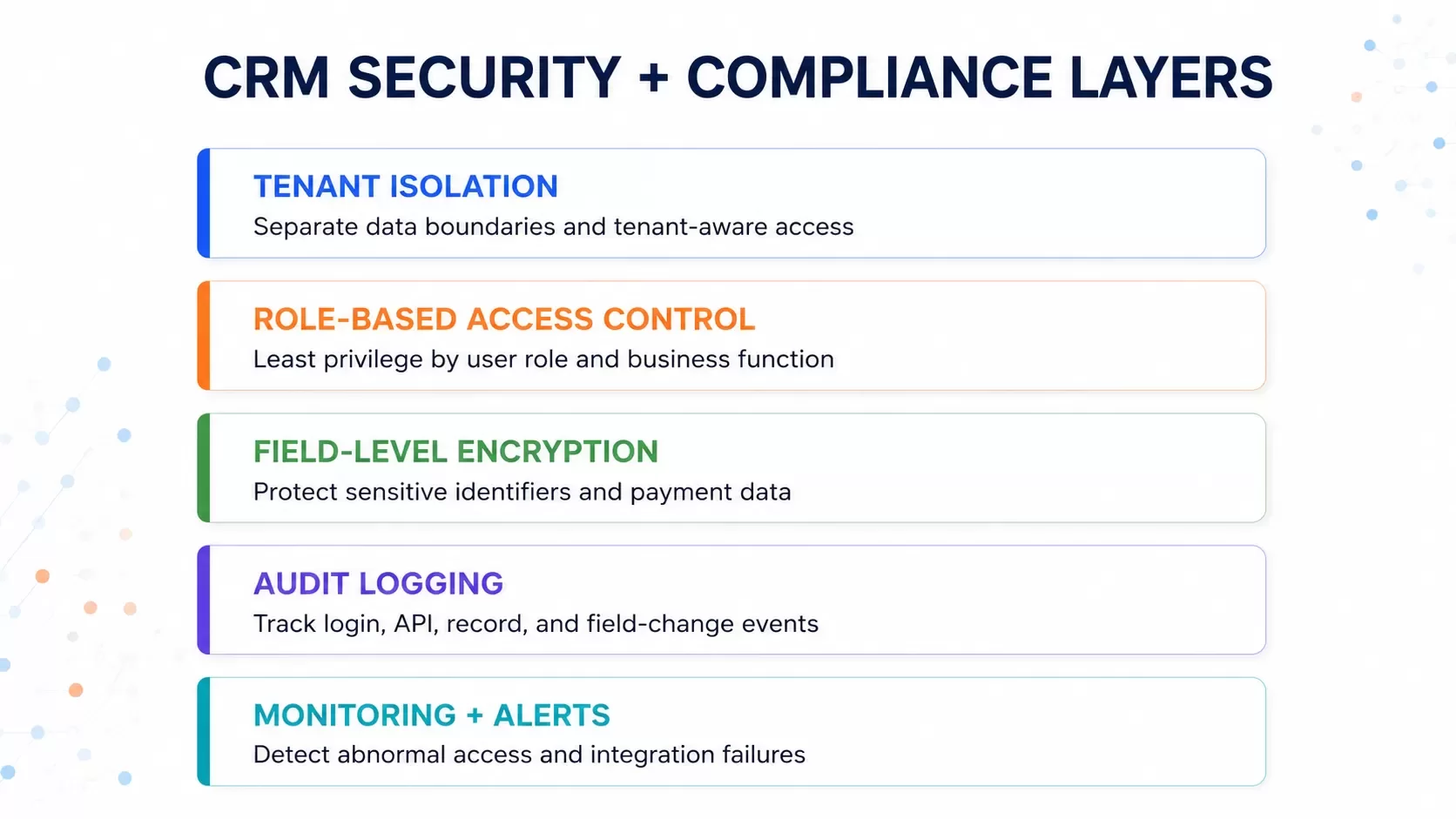
Security failures in CRM systems create cascading legal exposure and customer trust erosion that performance optimizations cannot remedy. Sensitive customer data needs layered defenses spanning encryption, access controls, audit mechanisms, and tenant isolation.
Field-Level Encryption for Sensitive Data
Field-level encryption protects specific data fields like social security numbers, credit card details, and passwords while leaving non-sensitive information available. Dynamics 365 uses SQL Server cell-level encryption with AES-256 algorithms for attributes containing credentials[3]. Salesforce Shield Platform Encryption extends protection to up to 60 fields per object with 10-year retention[35]. CloudFront makes encryption of up to 10 data fields per request possible at the edge and keeps sensitive information encrypted throughout the application stack until decryption occurs in authorized components[36].
Role-Based Access Control Implementation
RBAC assigns permissions through roles rather than individuals and simplifies administration as team structures evolve. Eight core privileges govern CRM operations: Create, Read, Write, Delete, Append, Append To, Assign, and Share[37]. Research indicates 40% of insider threats involve users with excessive privileges[37], while 81% of data breaches stem from weak or compromised passwords[37]. The principle of least privilege minimizes attack surfaces by restricting access to critical functions only.
Audit Logging and Compliance Tracking
Salesforce Shield's Field Audit Trail tracks changes to 60 fields per object with immutable storage retained for 10 years[35]. Event Monitoring captures over 50 event types including logins, API calls, and record views[35]. Organizations that implement complete audit trails cut response and audit times by 40%[37]. HubSpot provides native 90-day audit windows with options for extended retention through automated exports to cloud storage[35].
Multi-Tenancy Security Patterns
Tenant isolation prevents cross-tenant data access even when infrastructure is shared. IBM reports average data breach costs reached USD 4.88 million, representing a 10% annual increase[38]. Per-tenant encryption with unique keys ensures that compromising one tenant's credentials does not expose other tenants' data[39]. Implementation approaches range from dedicated databases per tenant for strong isolation to shared schemas with tenant ID filtering for resource efficiency[38].
Conclusion
You need to think over architectural choices that align with your organization's growth trajectory when building adaptable CRM systems. We got into patterns from monolithic approaches for rapid development to microservices architectures that enable enterprise-scale operations. The data model CRM strategies we covered, including relational schemas and graph databases, affect query performance and relationship mapping capabilities. Event-driven integration patterns and multi-level caching hierarchies are the foundations for live responsiveness. Security architecture with field-level encryption and role-based access controls protects sensitive customer data and maintains compliance. These design decisions compound over time and change your CRM from a simple contact database into a competitive advantage that scales with your business.
FAQs
CRM systems typically use three main architectural patterns: monolithic architecture for small-scale implementations where all functionality exists in a single codebase, microservices architecture for enterprise solutions that break functionality into independent services, and hybrid approaches that combine both patterns strategically. Event-driven architecture is also increasingly common for modern CRM systems requiring real-time capabilities.
Database design directly affects query performance and scalability. Relational databases organize customer data into connected tables with proper indexing, reducing query times from hundreds of milliseconds to just 2-5ms. Graph databases excel at relationship mapping, while hybrid models combine SQL for transactional data with NoSQL for unstructured content. Time-series databases optimize interaction history storage with compression techniques that reduce storage needs by 10x to 100x.
A scalable CRM system includes five core components: contact management for storing customer profiles, sales force automation for opportunity tracking, marketing automation for campaign management, customer service capabilities for interaction tracking, and analytics for business intelligence. These components work together through well-defined APIs and integration patterns to deliver comprehensive customer relationship management.
Microservices enable independent scaling of specific CRM functions based on demand. Organizations implementing microservices report 31% increases in development productivity and 28% faster time-to-market. Each service handles its specific workload—customer profiles, sales opportunities, or interaction tracking—allowing teams to optimize performance, choose appropriate technologies, and deploy updates without affecting the entire system.
Critical security measures include field-level encryption using AES-256 algorithms for sensitive data like social security numbers and credit cards, role-based access control to limit user permissions based on job functions, comprehensive audit logging that tracks changes and access patterns, and multi-tenancy security patterns that isolate customer data. These layered defenses protect against data breaches while maintaining regulatory compliance.
Planning a CRM rebuild, integration, or scalable architecture?
Hexagon IT Solutions helps businesses design CRM systems, API integrations, workflow automation, and secure customer data architecture that supports growth.
References
[1] https://learn.microsoft.com/en-us/azure/architecture/guide/architecture-styles/microservices
[2] https://www.cerbos.dev/blog/service-discovery-load-balancing-microservices
[4] https://dzone.com/articles/scalable-crm-architecture-and-data-modeling
[5] https://www.ibm.com/think/topics/microservices-design-patterns
[6] https://martinfowler.com/eaaCatalog/serviceLayer.html
[7] https://www.salesforce.com/sales/engagement-platform/opportunity-management-software/
[8] https://software-architecture-guild.com/guide/architecture/domains/bounded-contexts/
[9] https://www.confluent.io/use-case/event-driven-microservices-communication/
[10] https://www.redhat.com/en/topics/integration/what-is-event-driven-architecture
[12] https://www.appseconnect.com/how-real-time-sync-keeps-your-crm-erp-in-perfect-alignment/
[13] https://www.sap.com/india/resources/what-is-event-driven-architecture
[14] https://architect.salesforce.com/docs/architect/decision-guides/guide/event-driven.html
[15] https://www.codelessplatforms.com/crm-api-integration/
[16] https://www.pipedrive.com/en/features/crm-api
[17] https://dzone.com/refcardz/api-integration-patterns
[18] https://temporal.io/blog/mastering-saga-patterns-for-distributed-transactions-in-microservices
[19] https://learn.microsoft.com/en-us/azure/architecture/patterns/saga
[21] https://www.conduktor.io/glossary/saga-pattern-for-distributed-transactions
[23] https://www.striim.com/blog/data-synchronization-a-guide-for-ai-ready-enterprises/
[25] https://en.wikipedia.org/wiki/Cache_hierarchy
[28] https://aws.amazon.com/what-is/database-sharding/
[29] https://learn.microsoft.com/en-us/azure/architecture/patterns/sharding
[30] https://www.hmxzone.com/blog/database-indexing-for-crm-performance
[32] https://www.developernation.net/blog/8-indexing-strategies-to-optimize-database-performance/
[33] https://www.zigpoll.com/content/database-optimization-techniques-strategy-guide-director-scaling
[34] https://thenewstack.io/improve-microservices-with-these-new-load-balancing-strategies/
[35] https://vantagepoint.io/blog/sf/building-audit-trails-crm-compliance-guide
[36] https://docs.aws.amazon.com/AmazonCloudFront/latest/DeveloperGuide/field-level-encryption.html
[37] https://crmexpertsonline.com/role-based-access-control-in-crm-systems/
[38] https://redis.io/blog/data-isolation-multi-tenant-saas/
[39] https://medium.com/@justhamade/architecting-secure-multi-tenant-data-isolation-d8f36cb0d25e
[40] https://boostedcrm.com/crm/crm-architecture/
[41] https://frontegg.com/glossary/microservices
[42] https://www.confluent.io/learn/event-driven-architecture/


