





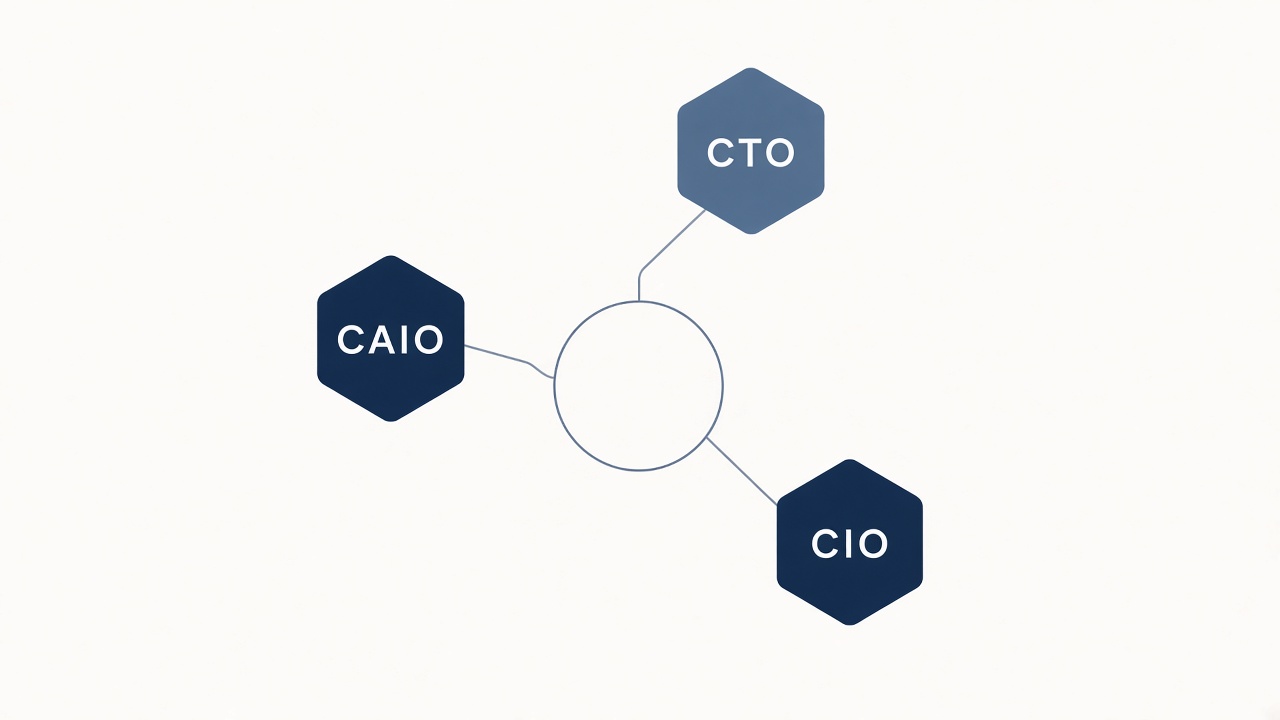
A chief AI officer (CAIO) is usually accountable for which AI use cases get funded and how model risk is accepted. A chief technology officer (CTO) is usually accountable for the engineering platforms those use cases run on. A chief information officer (CIO) is usually accountable for enterprise systems, identity, data policy, and the operational IT budget those systems already consume. AI spending stays confused until the organization writes down which of the three approves the tool, which funds the integration, and which accepts the residual risk.
Titles vary. Some firms have no CAIO and park the portfolio with the CIO or CTO. The work still has to sit somewhere. This Hexagon IT Solutions explanation is a practical split for budget owners, not a ranking of leadership models and not a claim about how most companies are organized.
What is each role actually for?
Answer: The CAIO chooses and sequences use cases, sets evaluation expectations, and is the person who can stop a use case that cannot be governed. The CTO owns build-versus-buy for platforms, engineering capacity, and the path from experiment to a supportable service. The CIO owns the systems of record, identity, vendor management for enterprise software, and the controls that keep data inside policy. If your chart uses different titles, assign the work anyway. Empty titles do not pay invoices.
Four buckets of AI spend
Arguments about “the AI budget” usually mix four different bills:
- Use-case delivery. The process or product change: workflow design, integration to the system of record, and training for the people who must use it. This is often a CAIO or business-owner budget, with CTO delivery capacity.
- Platform. Environments, model hosting, integration patterns, and the engineering needed so every team does not invent its own stack. This is typically CTO, sometimes shared with the CIO when the platform is an enterprise standard.
- Run cost. Licenses, inference, storage, and support after go-live. This belongs on an operating budget with a named owner, often the CIO if it is enterprise software, or the product owner if it is customer-facing.
- Control. Access reviews, evaluation records, logging, and security work so the use case can be explained later. This is shared, but the CIO or security lead should be able to refuse a launch that has no control plan.
When one leader is asked to fund all four, either the platform is starved or the control work is skipped. When nobody funds run cost, the pilot looks cheap until the renewal.
Where the budgets collide
The CIO sees another SaaS line that bypasses vendor review. The CTO sees a demo that needs unfunded integration before it can touch real data. The CAIO sees a use case leadership already announced, with no production path. Finance sees three sponsors and one vendor invoice. None of those collisions is solved by a new committee name. They are solved by naming the buyer, the integrator, the operator, and the risk acceptor before the purchase order.
Integration is the usual hidden bill. A tool that looks complete in a trial still has to read and write the systems people already trust. Scope that work explicitly, the way you would scope any other API integration, instead of treating it as a free side effect of the license.
A simple ownership test
For each proposed AI tool, write four names. Who can sign the purchase? Who will connect it to production data? Who will run it in month six, including access reviews? Who can shut it off if the evaluation fails? If any name is missing, the budget is not owned yet. Do not fill the blank with “the AI team” unless that team has headcount and authority.
Also decide the kill criteria in the same note: the data you will not send, the decision the tool must not make alone, and the date you will revisit the pilot. A use case without a stop rule becomes permanent by inertia.
What a board or ELT packet should show
Show a short portfolio: use case, business owner, budget bucket, system of record it touches, control gap, and which line pays in year two. Skip the vision slide as the decision document. Leaders can support an ambitious direction and still refuse a tool that has no operator. Digital transformation planning is useful here only when it separates platform work from use-case work and assigns both.
How Hexagon applies this
Hexagon IT Solutions helps leadership teams turn an AI idea into a delivery plan: integrations, security controls, and an operating owner. If the argument is still about who holds the budget, start with a systems audit of the tools already in use, then schedule a call to place the next use case in a single budget bucket.
Key takeaways
- CAIO, CTO, and CIO work overlaps; budget ownership does not have to.
- Split spend into use-case delivery, platform, run cost, and control.
- Do not buy until you can name the buyer, integrator, operator, and risk acceptor.
Want help putting this into practice?
Our team can look at your setup and suggest the right next step.
Talk to Our Team


