






If you are comparing the best healthcare software development companies in 2026, start with the problem you need to solve: shortlist ScienceSoft for healthcare-focused custom development, EPAM for enterprise engineering, and Thoughtworks for modernization. Choose by project fit and evidence—not by a universal agency ranking.
- The best healthcare software development companies solve your specific workflow, integration, and operational requirements.
- Shortlist ScienceSoft for healthcare-focused development, EPAM for enterprise engineering, and Thoughtworks for modernization.
- Require workflow demonstrations, integration evidence, and named delivery ownership before selecting a development partner.
- Separate administrative software requirements from clinical functionality and medical-device obligations.
Why this matters
A patient-facing application, a referral workflow, and a clinical decision-support system require different development plans. Treating them as interchangeable creates a weak brief and makes vendor proposals difficult to compare.
Your 2026 shortlist should reflect the system's intended use, the information it handles, and the consequences of failure. For patient-facing projects, start with the mobile app development guide for healthcare providers before comparing delivery partners.
The business outcome belongs at the center of the brief. Specify whether you need to reduce duplicate entry, improve referral visibility, simplify patient access, or replace a difficult-to-maintain application.
What makes the best healthcare software development companies
Use these criteria before reviewing company names. They distinguish a relevant delivery partner from a persuasive presentation.
- Workflow fit: The team can explain how your intended users complete their work, including exceptions and handoffs.
- Integration evidence: The proposal identifies connected systems, access dependencies, data ownership, and failure handling.
- Security accountability: Responsibilities for access control, audit records, incident handling, and protected information are explicit.
- Delivery ownership: You know who makes architectural decisions, accepts requirements, and resolves blocked work.
- Operational readiness: Testing, release approval, monitoring, support, and recovery belong in the delivery plan.
- Exit readiness: Your agreement addresses source code, documentation, infrastructure access, and knowledge transfer.
For your first comparison, ask every candidate to explain 3 workflows: the normal path, an exception, and recovery after failure. This is a recommended evaluation exercise, not a performance benchmark.
Healthcare development companies at a glance
This 2026 shortlist assigns each company a different evaluation role. The limitations below describe selection boundaries and project risks, not claims that a company lacks a capability.
| Company | Best for | Relevant focus | Key selection limitation |
|---|---|---|---|
| ScienceSoft | Healthcare-focused custom development | Publicly described healthcare software development services | General sector experience does not establish fit for your exact clinical or operational workflow |
| EPAM | Enterprise engineering programs | Software engineering and healthcare industry services | A broad engineering scope still needs clear workstream ownership and acceptance criteria |
| Thoughtworks | Modernizing software and delivery practices | Software delivery, modernization, and healthcare work | Modernization needs an agreed migration boundary and an accountable internal owner |
| Hexagon IT Solutions | A consultation to define a custom-software brief | A starting point for discussing requirements | A consultation is not evidence of healthcare-specific delivery experience |
1. ScienceSoft: best for healthcare-focused custom development
ScienceSoft publicly describes healthcare software development among its services. That makes ScienceSoft a relevant candidate when you want to evaluate a supplier around healthcare workflows rather than general application development alone.
Start with the actual work your software must support. A referral intake application needs different evidence from software that informs a clinical decision, even when both handle patient information.
ScienceSoft pros:
- Healthcare-specific service positioning gives your evaluation a relevant starting point.
- Custom development is relevant when packaged software does not match a necessary workflow.
- A focused brief lets you compare the proposed application against specific operational requirements.
ScienceSoft selection cautions:
- Healthcare experience does not automatically establish experience with your specialty or connected systems.
- Published service descriptions do not replace a review of the proposed team and architecture.
Best for: Buyers seeking a healthcare-focused custom-development candidate with a defined application scope.
Ask ScienceSoft to walk through an analogous workflow, explain its integration boundaries, and identify the responsibilities retained by your organization. Request 2 reference calls focused on comparable work rather than broad satisfaction questions.
Verdict: Hold until the proposed team demonstrates relevant workflow and integration experience.
2. EPAM: best for enterprise engineering programs
EPAM provides software engineering services and publicly describes work across healthcare. EPAM belongs on the evaluation list when the project extends beyond a single application into a wider technology program.
The deciding issue is coordination. An enterprise project needs an explicit division of responsibility across applications, data, infrastructure, security, and business operations.
EPAM pros:
- Its engineering focus is relevant to programs spanning several technical workstreams.
- Healthcare industry services provide a sector-specific starting point for discovery.
- A program-level evaluation lets you examine architecture and delivery coordination together.
EPAM selection cautions:
- A broad scope requires clear acceptance criteria for each workstream.
- An external engineering partner does not remove your need for an internal product owner.
Best for: Organizations evaluating a partner for coordinated enterprise engineering rather than an isolated feature build.
Ask EPAM to show how requirements move between workstreams and who resolves conflicting priorities. Require a dependency map that distinguishes work the delivery team controls from access, approvals, and decisions your organization must provide.
Use a sample release decision during evaluation. Ask who can approve deployment, who can stop it, and what happens when a connected system is unavailable.
Verdict: Hold until program ownership and cross-system dependencies are explicit.
3. Thoughtworks: best for modernizing software and delivery practices
Thoughtworks publicly describes software delivery, modernization, and healthcare work. Thoughtworks is a relevant candidate when your challenge includes changing an existing system and improving how your organization delivers software.
Modernization is not synonymous with replacing everything. Your brief should identify which capabilities remain, which change, and how users continue working during the transition.
Thoughtworks pros:
- Its modernization focus is relevant to evaluating incremental change rather than assuming a complete rewrite.
- Software-delivery expertise makes engineering practices part of the vendor discussion.
- A modernization brief can connect technical work to maintainability and release control.
Thoughtworks selection cautions:
- Modernization needs agreement on what to preserve as well as what to replace.
- Delivery changes require participation from your internal decision-makers and engineering owners.
Best for: Healthcare organizations evaluating changes to legacy applications and software-delivery practices together.
Ask Thoughtworks to explain the first migration boundary, the rollback approach, and the evidence required before retiring an existing component. Insist on a business reason for each proposed replacement.
A useful discussion starts with an operational constraint: a workflow that must remain available, a dependency that cannot change immediately, or a release process that needs clearer control.
Verdict: Hold until the migration plan protects essential workflows and assigns internal ownership.
4. Hexagon IT Solutions: best for a requirements consultation
A consultation is appropriate when you cannot yet write a clear development brief. Define the business problem before asking a supplier to estimate a solution or recommend an architecture.
Hexagon IT Solutions is a consultation option for buyers defining a custom-software brief. Treat that conversation as a scoping step, then evaluate healthcare-specific qualifications against the same requirements used for every other candidate.
Consultation pros:
- Gives you a structured starting point for discussing the business problem.
- Separates necessary workflow changes from optional features.
- Helps frame questions for a subsequent technical evaluation.
Consultation limitations:
- A discovery discussion does not establish healthcare implementation experience.
- Clinical, security, and integration requirements still need explicit technical review.
Best for: Founders and operations leaders who need to clarify requirements before selecting a development partner.
Bring a workflow description, a list of connected systems, and a named business owner. Ask what evidence is needed before the project can move from discussion to an implementation decision.
Verdict: Hold implementation approval until healthcare-specific requirements and delivery evidence are reviewed.
How to compare proposals without buying a presentation
Give each shortlisted company the same brief. Otherwise, you are comparing different interpretations of the project rather than different delivery approaches.
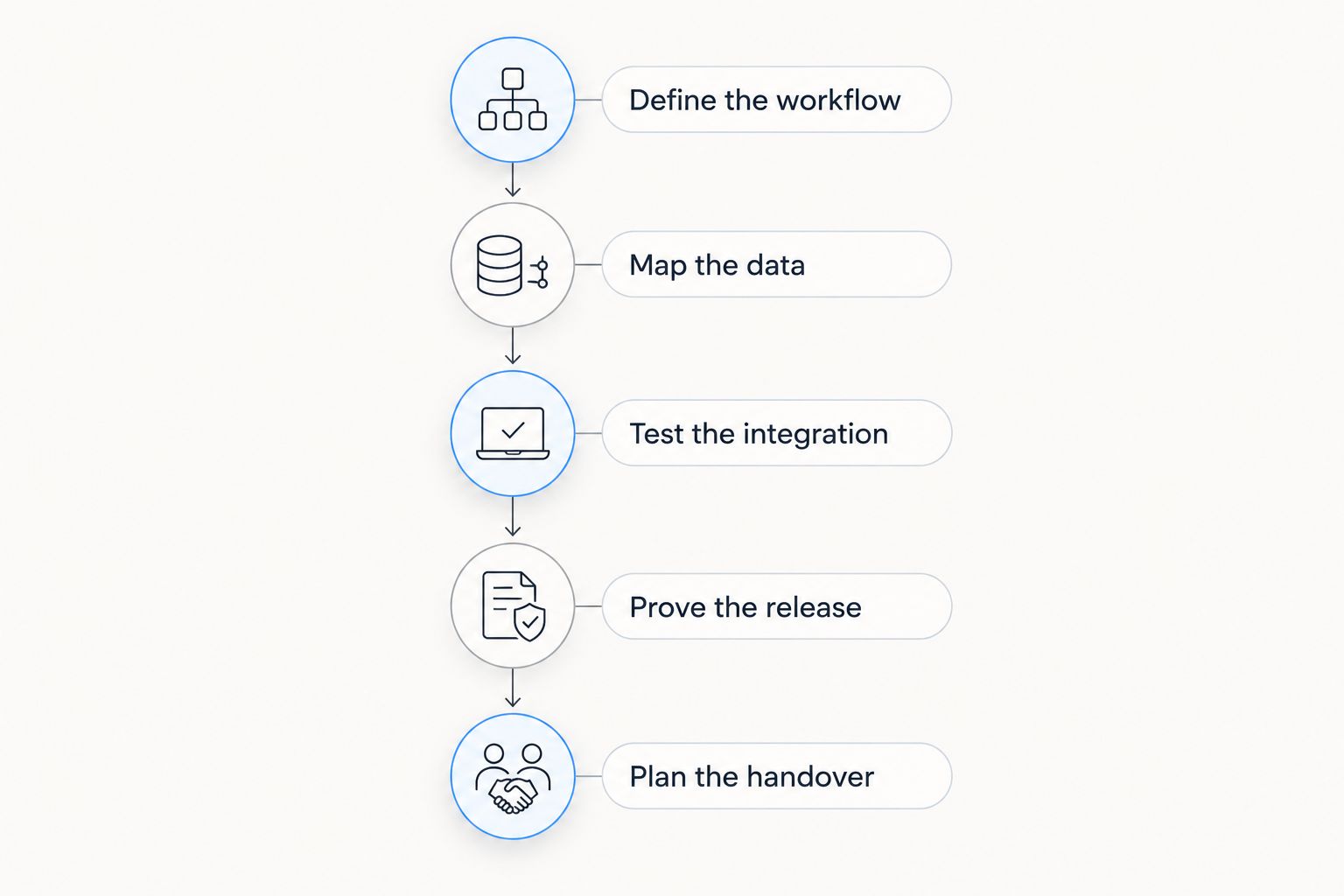
Define the workflow
Describe the users, trigger, required action, and expected outcome. Include exceptions such as incomplete records, duplicate submissions, rejected requests, and unavailable integrations.
Write acceptance criteria in observable terms. For example, specify that an authorized user must see a request's status and that a failed submission must enter an assigned recovery process.
Map the data
Identify where information originates, where it moves, and which system owns each record. Separate production information from the data used for development and testing.
Ask who can approve access and who can revoke it. Do not let the proposal treat identity management or record matching as an unspecified integration task.
Test the integration
Require an explanation of authentication, permissions, supported interfaces, and error handling. Naming a standard does not establish that a particular system exposes the required functionality.
HL7's FHIR documentation is a primary reference for understanding FHIR-based exchange. Your supplier still needs to establish the capabilities, restrictions, and access arrangements of each actual connection.
Prove the release
Define 1 pilot workflow before approving a wider rollout. Choose a bounded workflow that tests the project's important assumptions without making the pilot responsible for every requirement.
Set the acceptance decision before development begins. Identify the person who approves the result and the conditions that require further work.
Plan the handover
Specify access to source code, deployment instructions, operational documentation, and recovery procedures. Assign ownership of unresolved issues and future maintenance.
A handover is not complete because files changed hands. Your organization needs to understand how the application runs and who responds when it fails.
Check healthcare obligations separately from vendor claims
For a US healthcare project in 2026, distinguish privacy and security obligations from the application's clinical purpose. A supplier's healthcare marketing does not establish that your proposed implementation meets either set of requirements.
Use the HHS Office for Civil Rights' HIPAA guidance to inform your privacy and security review. Assess whether a business associate agreement is required for the proposed relationship; a contract label alone does not establish adequate technical controls.
If the software has a medical purpose, consult applicable FDA digital-health guidance and qualified regulatory advice. Do not classify the application solely from its name, interface, or intended audience.
Keep these reviews tied to scope. An administrative workflow and a clinical function deserve separate requirements and acceptance decisions.
How this shortlist is ranked
The 2026 ordering follows project fit: healthcare-focused custom development, enterprise engineering, modernization, then requirements discovery. It is an evaluation sequence, not a measured ranking of delivery quality.
The selection criteria remain the same across candidates: workflow fit, integration evidence, security accountability, delivery ownership, operational readiness, and exit readiness. Advance a supplier only when its proposed team provides evidence against your brief.
Which healthcare development company should you choose?
For an undecided buyer, start with the workflow—not the company size. Evaluate ScienceSoft for a defined healthcare application, EPAM for an enterprise engineering program, and Thoughtworks for modernization that includes delivery practices.
Your 2026 selection should end with a documented decision: why this team fits this scope, which assumptions remain open, and what must be demonstrated before implementation approval. A recognizable company name cannot make that decision for you.
FAQ
What's the best healthcare software development company?
The best healthcare software development company is the one whose proposed team can demonstrate experience relevant to your workflow, integrations, and operating requirements. Evaluate ScienceSoft for healthcare-focused custom development, EPAM for enterprise engineering, and Thoughtworks for modernization.
How do I verify a healthcare software developer's experience?
Ask for comparable workflow evidence, discussions with relevant references, and an explanation from the proposed delivery team. Examine integration dependencies, exception handling, and operational ownership rather than relying on a portfolio logo.
Does a healthcare software company make my application HIPAA compliant?
Hiring a healthcare software company does not by itself establish HIPAA compliance. Your organization must assess applicable obligations, contractual responsibilities, technical safeguards, and how the application will actually operate.
Should I replace my existing healthcare software or integrate it?
Integrate when the existing system remains fit for purpose and supports the access your workflow requires. Consider replacement when documented requirements cannot be met through an acceptable integration or incremental change; require evidence before approving either approach.
What should I prepare before contacting a healthcare development company?
Prepare a workflow description, intended users, connected systems, data requirements, and a named business owner. Include observable acceptance criteria so every candidate responds to the same problem.
One last thing
Ask every finalist to explain a failed transaction, not just a successful demonstration. Who sees the failure, who owns recovery, and how does the user know the issue is resolved?
That exercise exposes whether the proposal describes an application or an operating service. You need both the intended result and a workable response when something goes wrong.
Related guides
- How much does custom software development cost?
- How much does API integration cost?
- Is outsourcing software development worth it?
Schedule a consultation with Hexagon IT Solutions to discuss your healthcare software requirements.


