




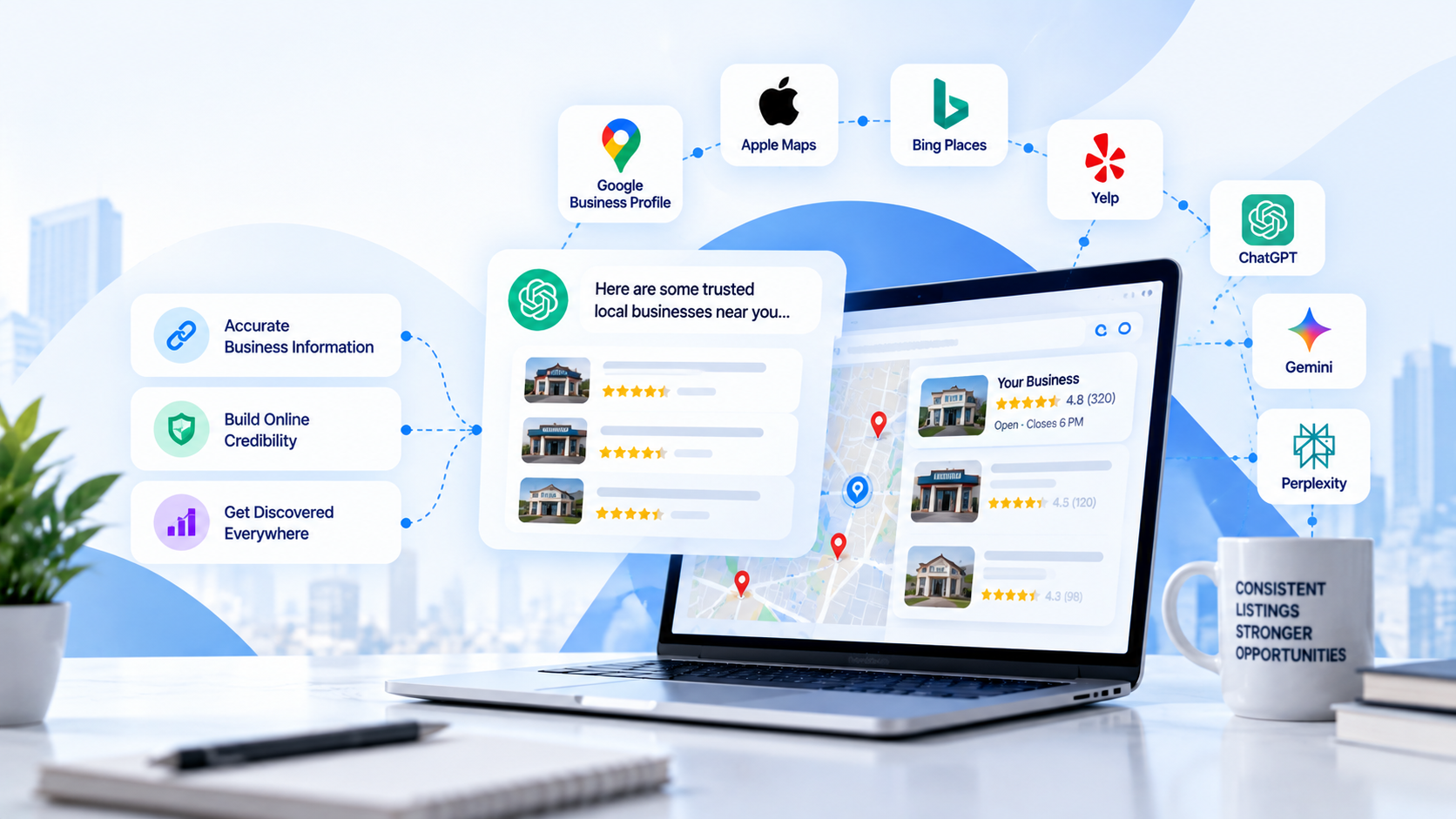
If you’ve built a website, you’ve probably had someone tell you: “You need to list your business on 50 different online directories right away!”
Years ago, that was the playbook.
Web developers and marketers would manually submit business information-Name, Address, and Phone number (known as NAP)-to online yellow pages, local sites, and business registries.
But in an era dominated by AI search engines like ChatGPT, Google Gemini, and Perplexity, are directory listings still worth your time?
Yes, but the strategy has changed.
Spamming low-quality directories for backlinks is dead. However, selective listings play a role in bridging traditional SEO (Search Engine Optimization) with the new world of GEO (Generative Engine Optimization).
The Old Way vs. The New Way: Quality Over Quantity
In the early days of SEO, Google treated directories like a giant popularity contest. The more websites that linked back to you, the higher you ranked.
This led to thousands of low-quality “link farms”- directories that existed only to sell links.
Today, search engines are too smart for that trick. Instead of collecting hundreds of random citations, industry experts agree that you only need listings on platform hubs that real humans actually use and search engines explicitly trust.
Darren Shaw, local search expert and founder of Whitespark , notes that broad “citation volume” isn’t the key driver it used to be. Instead, focusing on high-authority platforms that real customers visit- like Google, Apple Maps, Bing, Yelp, and industry-specific hubs-delivers the actual value.
Where SEO Meets GEO (Generative Engine Optimization)
To understand why directories still matter, you have to look at how search is evolving from traditional SEO into GEO.
- SEO (Search Engine Optimization): Helps your site rank in Google search results and the local “Map Pack”.
- GEO (Generative Engine Optimization): Helps your business get recommended inside AI answers generated by ChatGPT, Perplexity, and Google AI Overviews.
When someone asks a tool like ChatGPT, “Who is the best painter near me with weekend availability?” , the AI doesn’t just guess. It quickly scans trusted databases across the web to verify who you are, what you do, and whether you are legit.
If your business information is missing or inconsistent across key platforms, AI models lack the“confidence” to recommend you.
The 3 Types of Directories That Are Still Worth It
Not all directories are created equal. If you are deciding where to spend your time, break directories down into three main tiers:
| Directory Tier | Examples | Is It Worth It? | Why? |
|---|---|---|---|
| Tier 1: Core Map Platforms | Google Business Profile, Apple Maps, Bing Places | Essential | Drives direct phone calls, map directions, and core local rank signals. |
| Tier 2: Major & Industry Sites | Yelp, Tripadvisor, Better Business Bureau, Avvo (Law), Houzz (Contractors) | High Value | High human traffic, strong domain authority, and directly referenced by AI engines. |
| Tier 3: Local Hyper-Specific | City Chamber of Commerce, local business associations | Good Value | Connects your business to your actual geographic neighborhood. |
Note: At Good Oil Marketing , we regularly onboard new Local SEO clients. Often, they have been with another agency before us, and we’ll more often than not see that they haven’t done the very basics of online trust, for example filling out their Facebook Page, having a LinkedIn profile for the owner, or having an “About Us” page on their website.
Why Consistent Information Matters More Than Ever
When you list your business on directories, the single most important rule isconsistency.
Search engines cross-reference your business name, address, phone number, and operating hours across every platform they index.
Your address is listed as“123 Main St, Suite 4” on Google, but“123 Main Street #4” on Yelp and an old phone number on YellowPages.
Search algorithms get mixed signals, lowering your trust score and making AI tools hesitant to display your details.
According to research from BrightLocal and Search Engine Land , NAP accuracy across major platforms remains a foundational signal for local search authority and consumer trust.
Summary: The Verdict
Are directories worth listing on anymore?
If you are submitting to obscure, spammy link sites hoping for a quick ranking boost.
If you are claiming verified profiles on the top mapping apps, major review sites, and niche industry portals.
By keeping your information accurate on a focused set of high-quality directories, you build the trust foundation required to rank in classic Google searches and earn recommendations from modern AI search engines.


