




The wrong software choice creates expensive rework, low adoption, and missed ROI. The right process turns selection into a strategic decision instead of a feature comparison contest.
The selection of software is one of the most important decisions your organization will make. Choosing the wrong solution can lead to major reductions in ROI or complete project failure in extreme cases[1]. Software is often used for ten years or more. The total cost of ownership can be substantial[1][22]. 78% of buyers select software by committee[23]. This makes the process more complex. We've created this detailed guide to walk you through each stage of the software selection process. You'll learn how to build the right team and define clear requirements. You'll also learn how to review vendors and make decisions that deliver long-term value for your organization.
Understanding the Software Selection Process
What Makes Software Selection Critical for Your Business
Every organization has unique software requirements, yet most companies make the same mistakes during the software selection process[1]. Many software problems that derail projects can be traced back to poor assessment processes[1]. Fifty-eight percent of U.S. businesses regret at least one software purchase they made in the last 12 to 18 months[2]. Common reasons include high cost and onboarding difficulties[2]. The consequences of wrong choices extend way beyond the reach and influence of the original disappointment. Lidl, a 10,000-store international supermarket chain, chose ERP software that required heavy customization. After spending €500 million on that effort, the company was forced to abandon the implementation[2]. The right solution becomes an asset and improves operational efficiency. It enables informed decisions[2]. Making the wrong choice results in frustrated employees and lost productivity[2]. Software is often used for ten years or more, so the total cost of ownership can be substantial[1]. The time you invest in choosing the right product will have positive long-term effects[1].
Common Challenges in Selecting Software
The software selection process faces complexity from multiple angles. The software market is large and each organization's needs are different. This makes it difficult to attribute accurate costs to the assessment process[1]. But choosing the wrong software can lead to reductions in return on investment or complete project failure[1]. The software assessment process is carried out at an organizational level rather than individual level and often gives rise to inter-departmental political issues[1]. One individual alone rarely possesses the breadth of knowledge to choose a software option that meets all organizational requirements[1]. Communication channels across organizations can be fraught. Differing departmental objectives and lack of mutually beneficial collaboration lead to contradictory business and technical needs[1]. Business users are prone to making product selections based on unimportant and seldom-used visual analysis components[1]. Absolute end user autonomy can have chaotic results when a company strives to achieve data consistency[1].
Overview of the Multi-Step Selection Approach
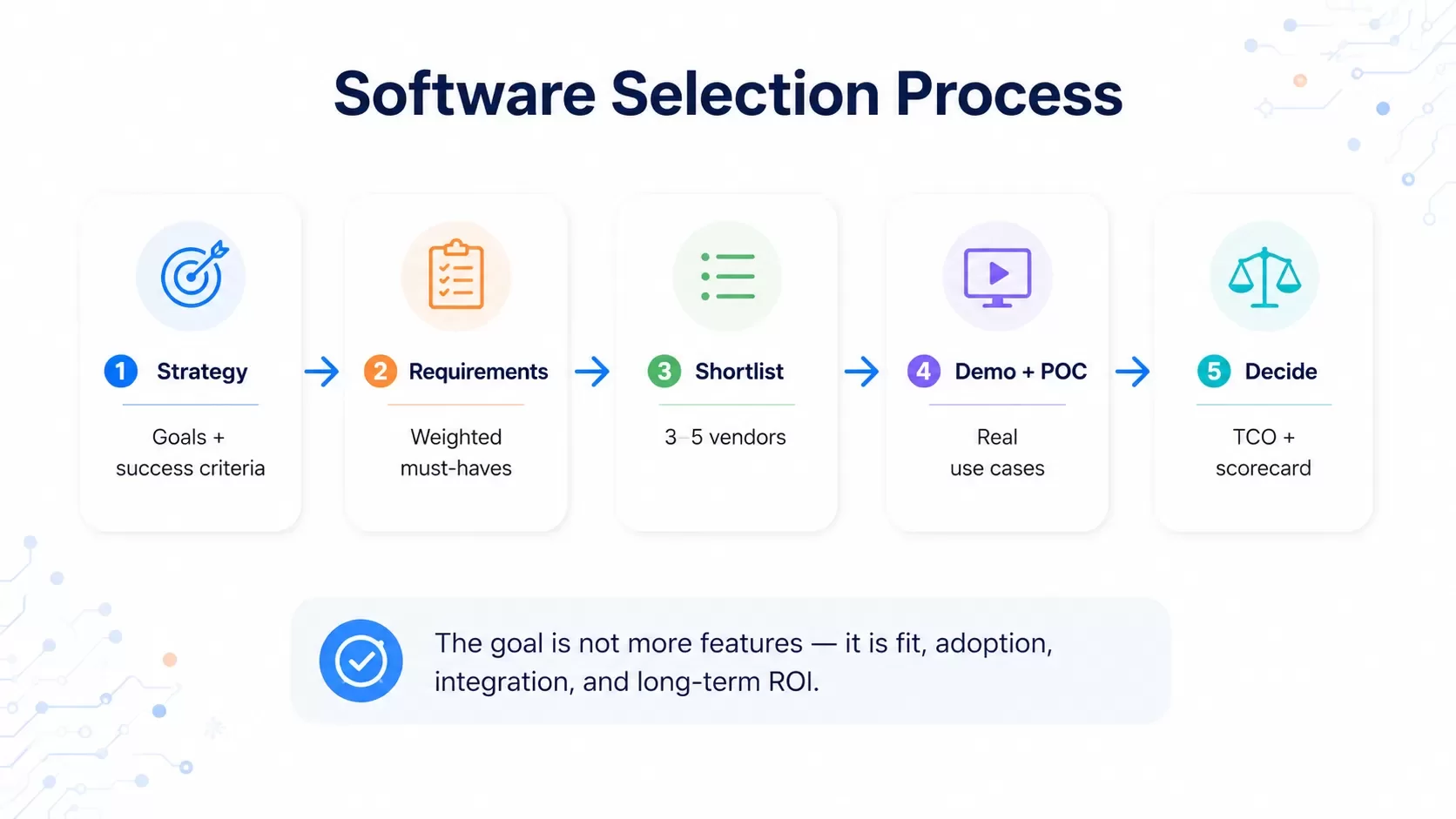
The best practice to assess software involves a multi-step process: 1. Definition of strategy and goals - Establish project objectives and success criteria 2. Requirements analysis - Conduct workshops and create weighted criteria lists 3. Software assessment - Perform market screening to identify suitable vendors, then narrow to a shortlist of 3-5 products[1] 4. Implementation - Deploy the selected product with proper testing and validation This structured approach ensures all stakeholders participation in the process and improve acceptance of the final product selection[1].
Building Your Selection Team and Securing Support
Key Team Members and Stakeholders You Need
The right team determines whether your software selection process succeeds or stalls. Cross-functional teams that include representatives from finance, operations, IT and frontline workers are 1.6 times more likely to achieve full system adoption within the first year compared to IT-led decision-making alone[3]. Your selection team should include executive leadership to set strategic direction and department heads who understand operational workflows. IT leadership handles technical assessment. End users provide daily workflow insights[4]. Business analysts translate operational needs into structured requirements. Legal and procurement teams review terms and maintain documentation[4]. Finance teams confirm total cost of ownership lines up with budget forecasts[4].
Executive Sponsorship Matters From Day One
Projects with active and visible executive sponsorship are six times more likely to meet or exceed objectives[3]. An executive sponsor serves as the senior leader who takes ownership at the strategic level. This ensures the project lines up with broader organizational goals[5]. This individual provides high-level direction and secures funding and resources. They act as the key liaison between stakeholders and the project team[5]. Research shows that 62% of completed projects had supportive sponsors[6]. The sponsor helps remove roadblocks and champions the project across departments. They maintain the project's connection with business priorities[5]. Even well-planned projects suffer from misalignment, internal resistance or lack of direction without an engaged sponsor[5].
Roles and Responsibilities Need Clear Definition
Clear roles prevent confusion. They make sure everyone stays accountable. The project manager coordinates people and steps throughout the selection process[7]. Department representatives gather input from their areas. They communicate initiatives back to their teams[8]. The IT department assesses technical fit, integration capabilities and security compliance[4].
IT and End-User Representatives Play Critical Parts
The IT department's expertise proves essential for complex projects requiring integration with other business applications and prioritizing security[9]. End user participation in design and assessment has been recognized as a critical success factor in information systems adoption[10]. Their firsthand insight into daily workflows helps make sure the software will be user-friendly and adopted across the organization[4].
Defining Your Requirements and Selection Criteria
Requirements Workshops
Requirements workshops gather stakeholders to identify, discuss and agree on what the solution must deliver. Project failure in 37% of surveyed organizations stems from inaccurate requirements gathering[11]. Stakeholder identification is often incomplete. Up to 40% of relevant stakeholders get overlooked during requirements gathering[12]. Structure your workshop with clear objectives, time-boxed agendas and diverse participation from decision makers, subject matter experts, end users and technical representatives. Brainstorming, mind mapping and process analysis help uncover needs. Document everything in real-time to enable rapid feedback loops.
A Weighted List of Criteria
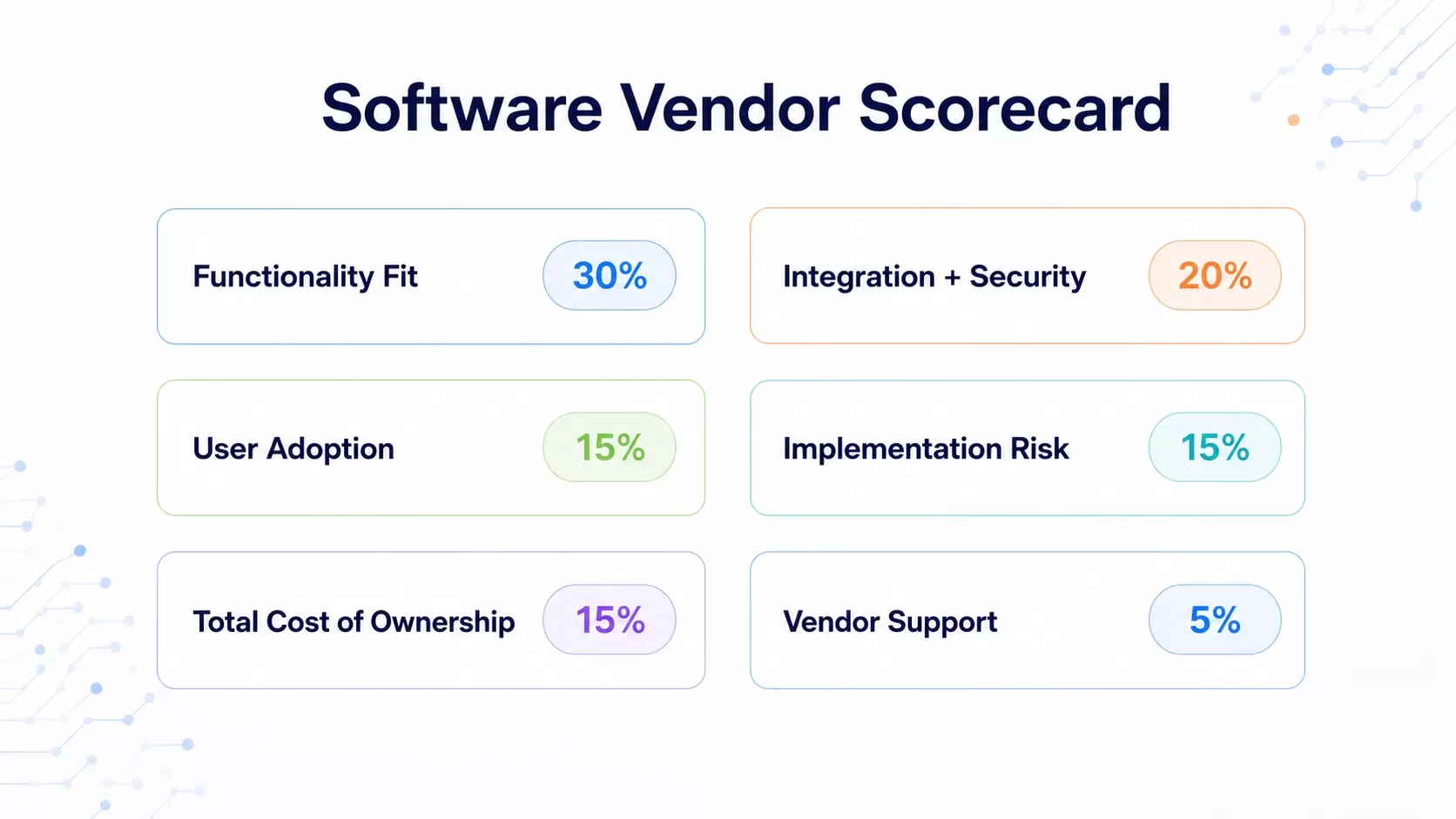
Weighted scoring reduces bias by assigning different importance levels to each criterion. Assign weights as percentages (totaling 100%) or numeric scales to criteria like functionality, ease of use, integration capabilities and cost. Each software option then receives scores against these criteria. Multiply by the weights to produce total scores for comparison.
Must-Have vs Nice-to-Have Features
Must-have features solve your core business problem and are mission-critical. Without these, your product doesn't exist. Nice-to-have features boost user experience but aren't needed to solve the main problem. Ask what happens if a feature isn't implemented to determine its true priority.
Factors That Affect Software Application Selection
Key factors include functionality coverage, total cost of ownership, scalability to handle growth, security compliance, vendor reputation and support, integration with existing systems and implementation time. Important are customization options, user interface design and the software delivery model.
Team Agreement and Documentation
Requirements will change during a project. 35% of requirements evolve throughout the lifecycle[12]. Establish formal change control processes and maintain version history. Secure stakeholder approval on documented requirements to establish your project baseline and prevent scope creep.
Evaluating Software Options and Making Your Decision
Conducting Initial Market Research
Research the marketplace to locate vendors offering software that solves your identified problems[13]. Use multiple sources including online review platforms, industry analyst reports, peer recommendations and vendor websites. Check customer satisfaction on sites like G2, Capterra and Software Advice to assess vendor reliability[14].
Creating a Shortlist of 3-5 Vendors
Narrow your list to a shortlist of 3-5 vendors[15][16]. Research shows that 85% of clients found marginal differences when doing side-by-side capability comparisons of leading platforms[17]. Being organized allows you to assess multiple vendors and decide on a best-fit platform in less than three months[17].
Running Product Demos with Real Use Cases
A shocking 81% of sales reps have lost a deal because of a bad demo[18]. Send vendors a demo brief including your business objectives, top criteria and specific workflows you want them to demonstrate[16]. Provide real-life scenarios and sample data from your environment. Research shows 79% of buyers prefer live walkthroughs over slide decks[18]. 66% say story-driven data and realism are top demo environment traits[18].
Testing Through Proof of Concept
Proof of concept verifies whether a solution meets your testing requirements before full implementation[19]. POCs prevent future disappointments by confirming the tool works in your specific context[19].
Calculating Total Cost of Ownership
Total cost of ownership measures all direct and indirect expenses throughout the software's lifespan[20]. Calculate acquisition costs, implementation and setup costs, training and support costs, operational costs, downtime costs and disposal costs or resale value[21].
Making the Final Selection
Line up with all stakeholders on whether the selected vendor meets business needs[16]. Use a vendor scorecard with weighted criteria to compare providers objectively[16].
Conclusion
You now have a proven framework to guide your software selection from start to finish. The right team and well-defined requirements help you avoid the expensive mistakes that plague most organizations. The effort you invest today will pay dividends for years. In fact, the right software becomes a strategic asset that improves growth. Follow this approach and stay focused on your must-have criteria. Your organization will make confident decisions that deliver value.
FAQs
The software selection process involves several critical steps: first, define your business case and strategic goals; second, gather requirements through stakeholder workshops and create weighted criteria lists; third, conduct market research and narrow down to a shortlist of 3-5 vendors; fourth, run product demos with real-world scenarios and conduct proof of concept testing; and finally, calculate total cost of ownership before making your final selection decision.
Executive sponsorship is crucial because projects with active and visible executive support are six times more likely to meet or exceed their objectives. An executive sponsor provides strategic direction, secures necessary funding and resources, removes organizational roadblocks, and maintains alignment with broader business priorities. Without engaged executive sponsorship, even well-planned software selection projects can suffer from misalignment and internal resistance.
Must-have features are those that solve your core business problem and are mission-critical for your operations—without them, the software cannot fulfill its primary purpose. Nice-to-have features enhance user experience and add value but aren't essential for solving the main problem. To determine a feature's priority, ask what would happen if it wasn't implemented; if the answer significantly impacts your core operations, it's a must-have.
Key factors include functionality coverage that meets your requirements, total cost of ownership including hidden costs, scalability to handle future growth, security and compliance capabilities, vendor reputation and quality of support, integration capabilities with existing systems, implementation timeline, customization options, user interface design, and the software delivery model that best fits your organization's needs.
Involving both IT and end-users is critical for successful software adoption. IT teams provide essential expertise on technical fit, integration capabilities, and security compliance, while end-users offer firsthand insights into daily workflows and usability requirements. Cross-functional teams that include both groups are 1.6 times more likely to achieve full system adoption within the first year compared to IT-led decisions alone, ensuring the selected software is both technically sound and practically useful.
Need help choosing or building the right system?
Hexagon IT Solutions helps companies evaluate software, design CRM/ERP workflows, integrate platforms, and build custom systems when off-the-shelf tools do not fit.
References
[1] https://barc.com/bi-software-selection-process/
[2] https://ultraconsultants.com/erp-software-blog/5-critical-enterprise-software-selection-factors/
[3] https://hartmanadvisors.com/6-strategies-for-a-successful-software-selection/
[5] https://www.projectmanager.com/blog/executive-sponsor
[6] https://www.pragmaticinstitute.com/resources/articles/product/executive-buy-in-your-key-to-success/
[8] https://www.myshyft.com/blog/cross-functional-committee-establishment/
[9] https://www.altamirahrm.com/en/blog/involving-it-in-hr-software-selection
[10] https://pubmed.ncbi.nlm.nih.gov/27198099/
[13] https://hartmanadvisors.com/components-of-an-effective-software-selection-process/
[14] https://www.alchemer.com/resources/blog/2022-buyers-guide-to-market-research-software/
[15] https://softteco.com/blog/finding-and-selecting-it-vendor
[16] https://www.cognism.com/blog/vendor-selection-process
[18] https://www.reprise.com/resources/blog/software-demo-best-practices
[19] https://testgrid.io/blog/poc-in-testing/
[20] https://www.ibm.com/think/topics/total-cost-of-ownership
[21] https://www.bill.com/learning/total-cost-of-ownership
[22] https://www.kloecknermetals.com/blog/choosing-software/


